

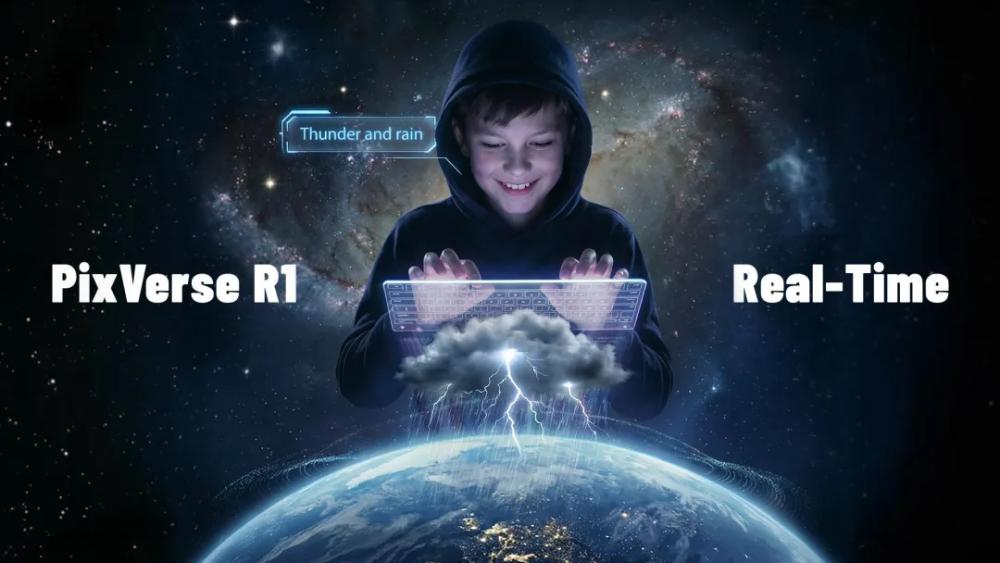
PixVerse-R1 Review: Next-Generation Real-Time World Model
PixVerse-R1 represents a paradigm shift in AI-driven video generation, moving beyond traditional, latency-bound workflows to offer a real-time, interactive, and infinitely streaming visual experience. Architected upon a native multimodal foundation model, this system enables visual content to respond instantly and fluidly to user input, effectively transforming video generation into a dynamic, continuous audiovisual simulation.
Key Features:
- Native Multimodal Foundation Model (Omni): At its core, PixVerse-R1 utilizes the Omni-model, a unified architecture that processes diverse modalities (text, image, video, audio) into a continuous token stream. This end-to-end approach, trained on real-world video data, allows the model to internalize physical laws and dynamics, enabling the creation of a consistent, responsive "parallel world."
- Infinite Streaming via Autoregressive Mechanism: Unlike conventional methods limited to fixed-length clips, PixVerse-R1 employs autoregressive modeling to achieve continuous, unbounded visual streaming. This is complemented by a memory-augmented attention mechanism that ensures temporal consistency and physical coherence over extended sequences.
- Real-time 1080P Instantaneous Response Engine (IRE): To overcome the computational demands of iterative denoising and achieve real-time performance, the IRE incorporates several key optimizations:
- Temporal Trajectory Folding: Direct Transport Mapping reduces sampling steps to 1-4, enabling ultra-low latency.
- Guidance Rectification: Classifier-Free Guidance overhead is bypassed by merging conditional gradients directly into the student model.
- Adaptive Sparse Attention: This technique mitigates long-range dependency redundancy, condensing the computational graph for efficient real-time processing.
Practical Applications and Use Cases:
PixVerse-R1 unlocks a new class of interactive audiovisual systems:
- AI-Native Games and Interactive Cinema: Dynamic environments and evolving narratives that respond in real-time to player actions.
- Immersive Simulations: Real-time VR/XR experiences and persistent digital environments.
- Creative Tools: Adaptive media art, interactive installations, and real-time content creation platforms.
- Educational and Training Systems: Dynamic learning environments that adapt to user progress.
- Simulation and Planning: Experimental research, scenario exploration, and complex industrial simulations.
By bridging the gap between human intent and instantaneous visual feedback, PixVerse-R1 facilitates new forms of human-AI co-creation and establishes a scalable computational substrate for the next generation of interactive media.


