

VecGlypher: Unified Vector Glyph Generation with Language Models
Vector glyphs, the fundamental building blocks of digital typography, are essential for creating high-quality, resolution-independent text. Traditionally, generating glyphs, especially for new font designs, has been a labor-intensive process requiring specialized software and expertise. While recent advancements in AI have shown promise in automating aspects of design, many learning-based approaches still rely on curated exemplar sheets or involve complex raster-to-vector post-processing steps, limiting their accessibility and the editability of the output.
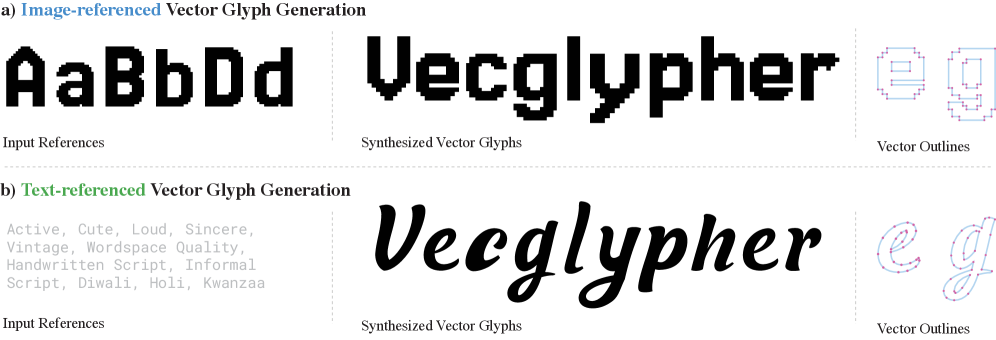
VecGlypher emerges as a groundbreaking solution, offering a unified framework that leverages the power of multimodal Large Language Models (LLMs) to generate vector glyphs directly from natural language descriptions or image exemplars. This innovative approach bypasses the need for intermediate raster representations, producing editable, watertight outlines in a single, streamlined pass. The core innovation lies in treating glyph generation as a language modeling task, where the model learns to autoregressively emit SVG path tokens that define the precise geometry of each character.
Key Features and Capabilities:
- Unified Multimodal Generation: VecGlypher seamlessly handles both text- and image-based conditioning. Users can describe the desired typographic style using natural language prompts (e.g., "high-contrast, narrow, slightly condensed, art-deco, playful") or provide a few reference glyph images. The model then synthesizes new glyphs that adhere to the specified style and character identity.
- Direct SVG Output: Unlike methods that generate raster images and then vectorize them, VecGlypher directly outputs SVG path data. This ensures that the generated glyphs are inherently editable, scalable, and free from rasterization artifacts, making them immediately usable in professional typography workflows.
- Typography-Aware Training Recipe: Achieving high-fidelity glyph generation requires more than just a powerful model. VecGlypher employs a sophisticated two-stage training strategy:
- Stage 1: Large-Scale Continuation (Envato Fonts): The model is initially fine-tuned on a massive dataset of 39,000 noisy fonts sourced from Envato. This stage is crucial for teaching the LLM the intricacies of SVG syntax, long-horizon coordinate prediction, and the general principles of geometric consistency required for drawing glyphs.
- Stage 2: Instruction Following (Google Fonts): Following the initial large-scale training, the model is further refined on a curated dataset of 2,500 expert-annotated Google Fonts. This stage focuses on aligning the model's understanding of textual descriptions and image styles with precise geometric outputs, enabling it to follow instructions and mimic visual appearances effectively.
- Data Engineering for Stability: To ensure stable and reliable long-sequence decoding, VecGlypher incorporates a meticulous data preprocessing pipeline. This includes deduplicating near-identical fonts, filtering out malformed or excessively long paths, normalizing coordinate systems, canonicalizing paths, and quantizing coordinates to a fixed precision (one decimal place). These steps significantly reduce the complexity of the output sequences and mitigate error propagation during generation.
- State-of-the-Art Performance: VecGlypher demonstrates superior performance compared to existing methods. In text-referenced generation, it significantly outperforms general-purpose LLMs and specialized vector-font baselines, often succeeding where others fail to produce valid glyphs. For image-referenced generation, it achieves state-of-the-art results, surpassing models like DeepVecFont-v2 and DualVector, particularly in cross-family out-of-distribution evaluations.
- Scalability and Model Size: The research highlights the critical role of model scale. Larger models (e.g., 27B and 70B parameters) exhibit markedly improved geometric fidelity and style consistency. Ablation studies confirm that both model scale and the two-stage training recipe are essential for achieving high-quality results.
- SVG Representation: The model serializes glyphs using a restricted set of SVG path commands (MoveTo, LineTo, Quadratic Bézier, ClosePath) with absolute coordinates, ensuring clean and predictable output. This simplified representation is optimized for LLM generation.
Target Users and Use Cases:
VecGlypher is designed to democratize font creation and empower a wide range of users:
- Graphic Designers: Quickly prototype new font styles, explore variations, and generate base glyph sets for further refinement. The ability to use text descriptions or image references accelerates the ideation process.
- Type Designers: Leverage VecGlypher as a powerful assistant for generating initial glyphs, especially for less common characters or when exploring complex stylistic variations. The direct SVG output facilitates seamless integration into existing design tools.
- Hobbyists and Enthusiasts: Lower the barrier to entry for font design, allowing individuals without extensive technical expertise to create custom fonts based on their creative ideas or visual inspirations.
- Developers: Integrate VecGlypher into applications for dynamic font generation, personalized text rendering, or creating unique typographic elements for digital interfaces and branding.
Unique Selling Points:
VecGlypher's primary unique selling proposition is its ability to bridge the gap between natural language or visual inspiration and precise, editable vector typography. By unifying text and image conditioning within a single, powerful LLM and directly generating SVG, it offers an unprecedented level of accessibility and efficiency in the font creation pipeline. The emphasis on a robust, typography-aware training methodology ensures that the generated glyphs meet the high standards required for professional use, setting a new benchmark for AI-driven creative tools in the domain of typography.
In essence, VecGlypher transforms the way we think about font design, making it more intuitive, accessible, and efficient by harnessing the generative capabilities of advanced AI.


