

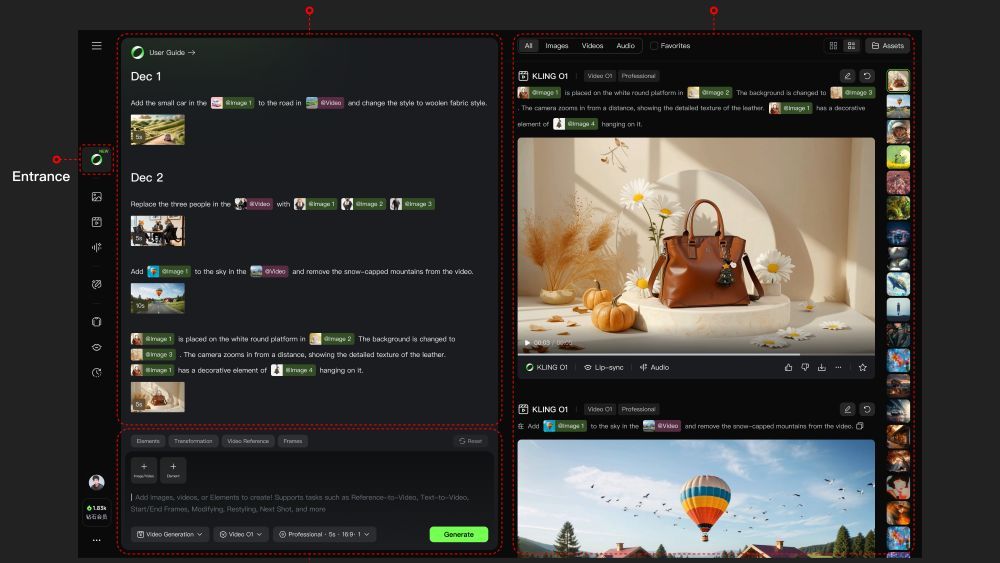
Overview of Kling VIDEO O1
Kling VIDEO O1 is a unified multimodal video model developed by Kuaishou’s AI team. Unlike traditional video tools that separate text-to-video, editing, style transfer, frame extension, or reference-based generation into different systems, VIDEO O1 integrates all these capabilities into one coherent model. It treats text, images, videos, and character references as interchangeable prompts, enabling creators to move from idea to generation — and from generation to detailed modifications — within a single workflow.
Core Concept and Technical Foundation
-
Multimodal Visual Language Understanding
VIDEO O1 interprets any uploaded asset — a picture, a short clip, a character reference sheet, or textual description — as part of the same semantic prompt. This allows the model to understand not only objects and styles but also spatial layout, lighting logic, camera movement, and character identity across angles. -
Unified Engine for All Tasks
Instead of switching between multiple specialized models, O1 supports text-to-video, reference-to-video, video editing, scene restyling, camera extension, and frame-based continuation in one system. This unified structure makes creative iteration smoother and minimizes style or character drift. -
Director-Style Interaction
Editing becomes a conversational process: rather than doing manual masking, keyframing, or compositing, users simply type natural-language instructions such as “remove background pedestrians,” “turn the lighting into warm dusk,” or “change the character’s jacket to a leather coat.” The model performs semantic-level reconstruction automatically.
Key Capabilities
-
Text-to-Video Generation
Create 3–10 second clips purely from text prompts, with cinematic camera motions, stylized looks, or realistic scenes depending on the description. -
Reference-to-Video Creation
Use one or multiple images — or start/end frames — to generate consistent characters, environments, and props throughout the video. Ideal for maintaining identity across shots. -
Video Editing and Scene Modification
Upload an existing clip and modify it by replacing elements, adjusting lighting, altering styles, or removing/adding objects. O1 handles complex visual logic at pixel level. -
Camera and Scene Extension
Extend shots beyond the original boundaries, continue camera motion, or expand environments while preserving continuity in lighting, composition, and design. -
Style and Character Consistency
The model focuses on stable appearance, structure, and tone across generation steps, addressing one of the biggest weaknesses in earlier AI video systems.
Why It Matters
For creators, marketers, studios, and solo producers, VIDEO O1 reduces the need for traditional video pipelines. Tasks that normally require filming, editing, compositing, and VFX can now be handled by prompt-based instructions. It enables:
- Faster prototyping of concepts and storyboards
- Low-cost production of branded or narrative short-form content
- High-quality consistency across shots for characters and scenes
- A drastically lower skill barrier — anyone can “direct” in natural language
Current Limitations
The standard output length is usually 3–10 seconds per generation, though shot extension features can lengthen sequences. Like all AI video models, O1 may struggle with extremely complex multi-character scenes or highly detailed physical interactions.
Conclusion
Kling VIDEO O1 represents a significant step toward unified AI-driven video creation. By merging generation and editing into one multimodal engine, it streamlines the entire content process — from idea to polished output — while maintaining consistency and creative flexibility. For individuals and teams seeking rapid, controllable, and high-quality video creation, VIDEO O1 signals a new era of “prompt-based filmmaking.”


