

Image to Prompt Generator: Revolutionizing AI Art Creation
The digital art landscape is rapidly evolving, driven by the incredible advancements in Artificial Intelligence. AI art generators like Stable Diffusion, Midjourney, and DALL-E have opened up new avenues for creativity, allowing users to generate stunning visuals from simple text descriptions. However, crafting the perfect text prompt, or "prompt engineering," can be a complex and time-consuming process. This is where the Image to Prompt Generator steps in, offering a powerful and intuitive solution to bridge the gap between visual inspiration and AI-generated art.
What is the Image to Prompt Generator?
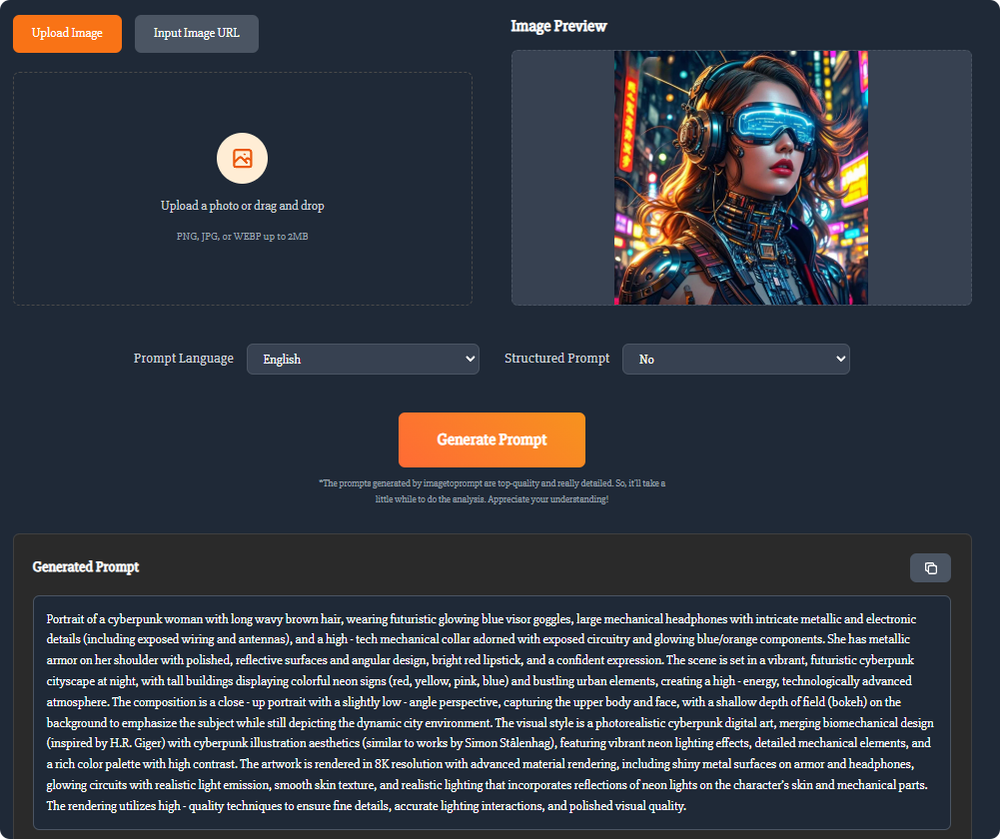
At its core, the Image to Prompt Generator is an AI-powered tool designed to analyze an input image and automatically generate a detailed, descriptive text prompt that accurately reflects the image's content, style, and mood. Instead of manually trying to articulate the nuances of a visual piece, users can simply upload an image, and the AI does the heavy lifting, producing high-quality prompts suitable for use with leading AI art generation platforms.
Key Features and Functionality:
-
AI-Powered Image Analysis: The cornerstone of the tool is its sophisticated AI engine. This engine is trained on vast datasets of images and their corresponding text descriptions, enabling it to identify and interpret a wide range of visual elements. It analyzes:
- Subject Matter: Identifying the main objects, characters, and scenes within the image.
- Artistic Style: Recognizing artistic movements, techniques (e.g., oil painting, watercolor, digital art, photography), and specific artist influences.
- Color Palette and Mood: Determining the dominant colors, lighting conditions, and the overall emotional tone of the image (e.g., vibrant, somber, serene, chaotic).
- Composition and Framing: Understanding the arrangement of elements, camera angles, and perspective.
- Details and Textures: Capturing intricate details, material properties, and surface textures.
-
High-Quality Prompt Generation: The output is not just a basic description but a comprehensive and detailed prompt. These prompts are crafted to be effective with AI art generators, often including keywords related to style, lighting, composition, and specific artistic modifiers that enhance the final generated image. The goal is to provide prompts that are both descriptive and actionable for AI models.
-
Multi-Platform Compatibility: The generated prompts are designed to be versatile and work seamlessly with popular AI art generators such as:
- Stable Diffusion: Known for its flexibility and open-source nature.
- Midjourney: Renowned for its artistic and often surreal outputs.
- DALL-E: Developed by OpenAI, offering high-fidelity image generation.
- And other similar text-to-image models.
-
Multi-Language Support: Recognizing the global nature of AI art creation, the tool supports prompt generation in multiple languages. This feature allows users from diverse linguistic backgrounds to leverage the tool effectively, making AI art more accessible worldwide. Supported languages include English, Spanish, German, French, Portuguese, Simplified Chinese, Traditional Chinese, Arabic, Russian, Japanese, and Korean.
-
User-Friendly Interface: The platform boasts a clean, intuitive, and responsive user interface. The process is straightforward: upload an image, select the desired prompt language, and click generate. The visual design is modern and engaging, with a dark theme that is easy on the eyes during extended creative sessions.
-
Free and Accessible: A significant advantage of the Image to Prompt Generator is that it is offered completely free of charge, with no usage limits. This democratizes access to advanced prompt engineering capabilities, empowering hobbyists, students, and professionals alike without financial barriers.
-
Privacy Focused: The tool prioritizes user privacy. Uploaded images are processed in real-time and are not stored on the servers after the prompt is generated, ensuring that users' visual content remains confidential.
Use Cases and Target Audience:
The Image to Prompt Generator caters to a broad spectrum of users involved in digital art and AI:
-
AI Artists and Hobbyists: For those who find inspiration in existing images and want to recreate similar aesthetics or explore variations. It helps overcome the "blank canvas" problem and provides a starting point for complex creations.
-
Graphic Designers and Illustrators: Designers can use the tool to quickly generate prompts for mood boards, concept art, or to explore different stylistic interpretations of their existing work. It can accelerate the ideation phase and provide new creative directions.
-
Content Creators and Marketers: Individuals looking to generate unique visuals for social media, blog posts, or marketing campaigns can use the tool to translate visual ideas into effective AI art prompts.
-
Game Developers and 3D Artists: The tool can assist in generating prompts for game assets, character concepts, environmental designs, or textures, speeding up the asset creation pipeline.
-
Educators and Students: It serves as an excellent educational tool for understanding how AI interprets images and how text prompts influence AI art generation. Students can learn prompt engineering principles by analyzing the generated prompts.
-
Researchers and Developers: The underlying technology and the quality of generated prompts can be of interest to those studying AI image analysis and natural language generation.
Practical Applications:
- Recreating Styles: Upload a painting by a specific artist and generate a prompt to create new images in that artist's style.
- Generating Variations: Input a generated AI image and get a prompt that can be used to create variations with slight modifications.
- Concept Art Ideation: Use a reference image for a character, creature, or environment to generate detailed prompts for further AI development.
- Understanding AI Interpretation: See how the AI breaks down a complex image into descriptive text, offering insights into prompt engineering.
- Accelerating Workflow: Quickly obtain descriptive prompts for any visual idea, saving significant time compared to manual prompt writing.
Technical Aspects:
The Image to Prompt Generator likely employs a combination of advanced computer vision and natural language processing (NLP) techniques. This could involve:
- Convolutional Neural Networks (CNNs): For image feature extraction, identifying objects, scenes, and textures.
- Transformer Models (like CLIP or similar architectures): For aligning image features with textual descriptions, understanding the semantic relationship between visual content and language.
- Large Language Models (LLMs): For generating coherent, detailed, and stylistically appropriate text prompts based on the analyzed image features.
The training process would involve a massive dataset of image-prompt pairs, allowing the model to learn the intricate mapping between visual elements and their textual representations. The multi-language support suggests the use of multilingual models or translation layers integrated into the pipeline.
The Future of Image to Prompt:
As AI technology continues to advance, tools like the Image to Prompt Generator will become even more sophisticated. Future iterations might include:
- More Granular Control: Allowing users to specify which aspects of the image they want emphasized in the prompt (e.g., focus on style, subject, or mood).
- Integration with AI Art Platforms: Direct integration with popular AI art generators for a seamless workflow.
- Advanced Style Transfer Prompts: Generating prompts that can replicate highly specific and nuanced artistic styles.
- Video to Prompt Generation: Extending the functionality to analyze video frames and generate prompts for dynamic scenes.
In conclusion, the Image to Prompt Generator is an invaluable tool for anyone working with AI art. It democratizes prompt engineering, enhances creative workflows, and unlocks new possibilities for visual expression by transforming images into powerful AI prompts. Its free accessibility, ease of use, and focus on quality make it a must-have resource in the rapidly expanding world of AI-generated art.


