

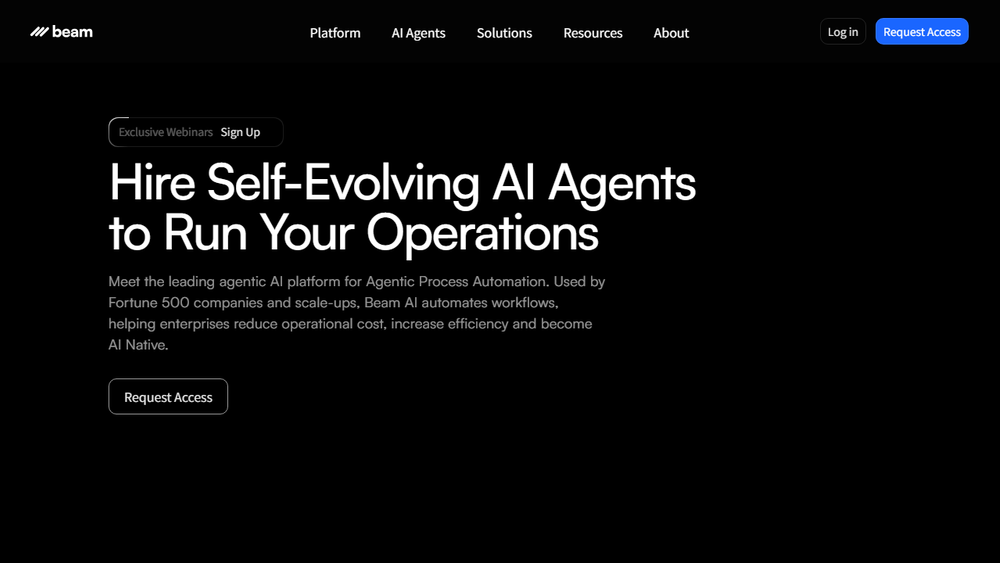
Beam AI positions itself as a premier platform for agentic automation and the development of AI agents. The core promise of Beam AI is to empower users to automate complex processes by building and deploying sophisticated AI agents with remarkable speed and ease. The platform emphasizes a user-friendly experience, allowing individuals and businesses to create and integrate these agents into their existing workflows in a matter of minutes, thereby significantly enhancing operational efficiency and productivity.
At its heart, Beam AI is designed to democratize access to advanced AI capabilities. It caters to a broad spectrum of users, from developers looking to integrate AI into their applications to business professionals seeking to automate repetitive tasks and gain deeper insights from their data. The platform's intuitive interface and streamlined development process are key differentiators, aiming to lower the barrier to entry for AI adoption. This focus on speed and simplicity means that users can move from conceptualization to deployment of functional AI agents much faster than traditional development cycles would allow.
The concept of "agentic automation" implies that the AI agents developed on Beam AI are not merely passive tools but are capable of taking initiative, making decisions, and performing actions autonomously within defined parameters. This is crucial for tasks that require a degree of intelligence and adaptability, such as customer support, data analysis, content generation, and complex workflow management. The platform likely provides a robust set of tools and functionalities for defining agent behaviors, setting objectives, and managing their operational lifecycle.
Key features of Beam AI are expected to include:
- Agent Creation Tools: An intuitive interface for designing, configuring, and customizing AI agents. This might involve visual programming tools, natural language interfaces for defining agent tasks, or SDKs for more advanced customization.
- Deployment Capabilities: Seamless integration of AI agents into existing business processes and applications. This could involve APIs, webhooks, or direct integrations with popular business software.
- Workflow Automation: The ability to orchestrate multiple AI agents to work together, forming complex automated workflows that can handle multi-step processes.
- Scalability and Performance: The platform is likely built to handle a high volume of agent operations, ensuring that automation remains efficient even as demand grows.
- Integration with AI Models: Access to and integration with various underlying AI models, potentially including large language models (LLMs), computer vision models, and other specialized AI technologies.
- Monitoring and Analytics: Tools to track agent performance, monitor their activity, and gain insights into the effectiveness of automation efforts.
Beam AI's target audience is likely diverse, encompassing:
- Businesses of all sizes: From startups to large enterprises looking to leverage AI for competitive advantage.
- Developers: Who can use Beam AI to quickly build and deploy AI-powered features into their applications.
- Product Managers: Seeking to enhance product offerings with intelligent automation.
- Data Scientists and Analysts: Who can utilize AI agents for more efficient data processing and analysis.
- Individuals: Looking to automate personal tasks and improve productivity.
The platform's emphasis on "agentic automation" suggests a future-forward approach to AI, moving beyond simple task execution to more intelligent, autonomous systems. This aligns with the growing trend towards more sophisticated AI applications that can understand context, learn from experience, and proactively solve problems. By providing a comprehensive platform for building and deploying these agents, Beam AI aims to be at the forefront of this AI revolution.


