

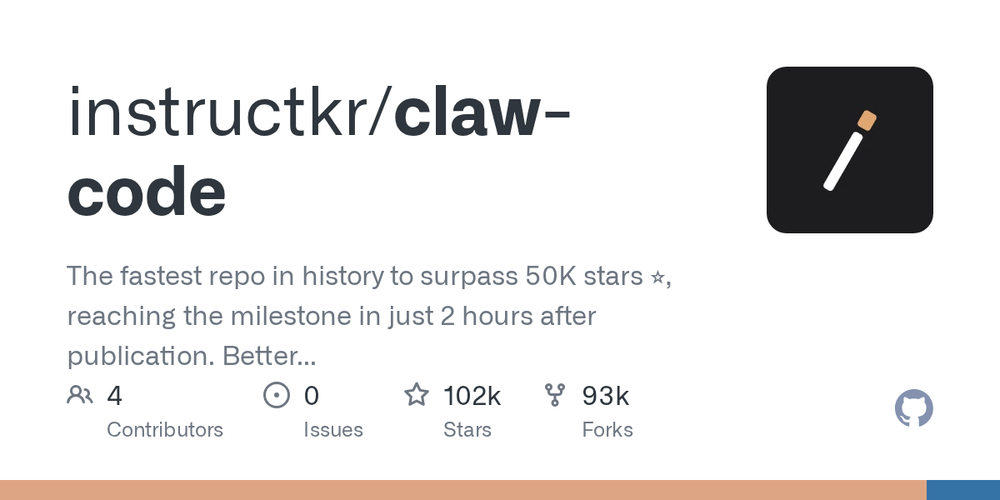
Claw Code: Revolutionizing Harness Engineering with AI and Rust
Claw Code is a groundbreaking project that has rapidly ascended to prominence in the developer community, achieving the remarkable feat of surpassing 50,000 stars on GitHub in a mere two hours after its initial publication. This rapid adoption underscores its significant impact and the urgent need it addresses in the realm of harness engineering and AI-powered development tools.
The Genesis of Claw Code: A Response to Exposure
The project's origin story is as dramatic as its rise to fame. On March 31, 2026, at 4 AM, the developer behind Claw Code, Sigrid Jin, experienced a surge of notifications as the project's source code was exposed. Facing potential legal repercussions and a community in a frenzy, Jin responded with characteristic engineering pragmatism: a rapid, clean-room port of the core features to Python, completed and pushed before sunrise. This act not only demonstrated resilience but also highlighted the project's foundational architectural principles, which were deemed valuable enough to warrant a swift, independent reimplementation.
The Power of AI-Assisted Development: Oh My Codex and Oh My Open Code
This rewrite was not a solitary effort but a testament to the power of advanced AI-assisted development workflows. The entire process, from understanding the original harness structure to producing a functional Python codebase with tests, was orchestrated using oh-my-codex (OmX), a workflow layer developed by Yeachan Heo. OmX leverages OpenAI's Codex for scaffolding, orchestration, and architectural direction. Furthermore, oh-my-opencode (OmO), created by code-yeongyu, was employed for accelerating implementation, cleaning up the code, and providing verification support. Key workflow patterns utilized included OmX's $team mode for parallel code review and architectural feedback, and $ralph mode for persistent execution, verification, and disciplined completion. These AI-driven methodologies allowed for an unprecedented pace of development and a high degree of fidelity in the reimplementation.
Architectural Pillars: Rust and Python
Claw Code is built upon two powerful programming languages, each serving distinct but complementary roles:
-
Rust: The Rust port, primarily found in the
rust/directory, serves as the core harness runtime. It is engineered for performance, memory safety, and concurrency, making it ideal for demanding systems-level tasks. The Rust workspace includes modules for:crates/api-client: A robust API client with abstraction layers for various providers, OAuth support, and real-time streaming capabilities.crates/runtime: Manages session state, data compaction, MCP (Meta-Cognitive Process) orchestration, and prompt construction.crates/tools: Defines tool manifests and provides a flexible execution framework for integrating external functionalities.crates/commands: Handles slash commands, facilitates skills discovery, and allows for configuration inspection.crates/plugins: Implements a plugin model, a hook pipeline, and includes bundled plugins for extended functionality.crates/compat-harness: Offers a compatibility layer for seamless integration with upstream editor environments.crates/claw-cli: A command-line interface providing an interactive REPL, markdown rendering, and project bootstrapping flows.
-
Python: The Python port, located in the
src/directory, represents the current focus for cleanroom reimplementation and rapid iteration. It aims to capture the architectural patterns and core functionalities of the original system without relying on proprietary source code. The Python workspace includes:port_manifest.py: Summarizes the current Python workspace structure and its components.models.py: Defines dataclasses for subsystems, modules, and backlog state management.commands.py: Contains metadata for Python-side command ports.tools.py: Holds metadata for Python-side tool ports.query_engine.py: Renders a summary of the Python porting progress based on the active workspace.main.py: Serves as a CLI entrypoint for manifest and summary output.
Key Features and Use Cases
Claw Code is designed to empower developers, researchers, and AI enthusiasts with advanced tools for harness engineering and AI development. Its key features and use cases include:
- Rapid Star Growth: The project's unprecedented growth highlights its immediate relevance and appeal to a broad developer audience.
- AI-Assisted Development: Leveraging OmX and OmO, developers can accelerate their workflows, automate repetitive tasks, and improve code quality through AI-driven assistance.
- Harness Engineering: The project provides a deep dive into the architecture of agent systems, focusing on tool integration, task orchestration, and runtime context management.
- Cleanroom Reimplementation: The Python port demonstrates a commitment to ethical development by recreating functionality without direct code copying, adhering to legal and ethical standards.
- Performance and Safety: The Rust implementation prioritizes performance and memory safety, crucial for robust and scalable AI systems.
- Extensibility: The plugin system and tool manifest definitions allow for easy integration of new functionalities and custom agent behaviors.
- Community Collaboration: The project actively fosters a community through its Discord server, encouraging collaboration and knowledge sharing among AI enthusiasts and developers.
Backstory and Vision
The project's backstory, involving the exposure of its original source code and the subsequent rapid rewrite, is a compelling narrative of innovation under pressure. Sigrid Jin's experience, documented in The Wall Street Journal's feature "The Trillion Dollar Race to Automate Our Entire Lives," underscores the significant impact and widespread interest in tools like Claw Code. The project's vision extends beyond a simple code repository; it aims to be a platform for exploring the future of AI-driven development, where human creativity is amplified by intelligent tools and robust engineering practices.
Community and Support
Claw Code actively cultivates a vibrant community, particularly through its Discord server, which serves as a hub for discussions on LLMs, harness engineering, agent workflows, and more. This collaborative environment is crucial for the project's ongoing development and for pushing the boundaries of what's possible in AI-assisted software engineering. The project also emphasizes ethical considerations, as evidenced by its cleanroom reimplementation and its stance on not claiming ownership of the original exposed material, while still providing a valuable, independently developed alternative.
Future Directions
With the Rust port nearing completion and active collaboration with OmX's creator, Claw Code is poised for even greater capabilities. The focus remains on delivering a faster, more memory-safe, and feature-rich harness engineering platform that empowers developers to build the next generation of AI-powered applications. The project's journey from a rapid response to a foundational tool for AI development showcases its adaptability, innovation, and the strong community support it has garnered.

