

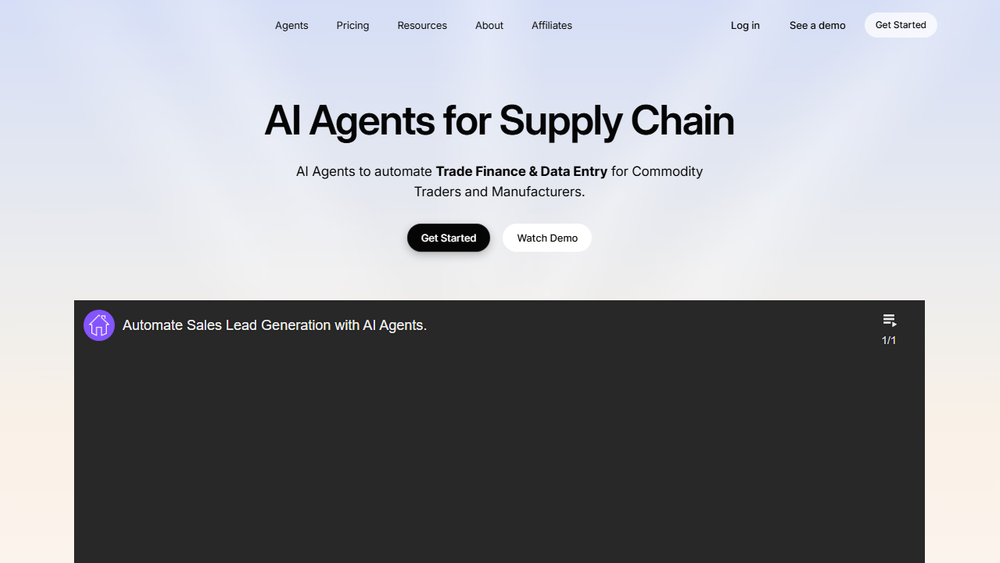
This webpage introduces an AI Assistant specifically designed for supply chain managers. The core offering is a suite of generative AI-powered agents that aim to automate critical workflows within the supply chain. These workflows include sales, procurement, and inventory management.
The product leverages advanced AI capabilities to streamline operations, reduce manual effort, and potentially improve efficiency and decision-making for supply chain professionals. The description highlights the "generative AI-powered Agents" as the key technology, suggesting that these agents can create content, analyze data, and perform tasks autonomously or semi-autonomously.
For sales workflows, the AI assistant could potentially automate tasks such as lead generation, customer communication, sales forecasting, and order processing. In procurement, it might assist with supplier identification, negotiation, purchase order generation, and risk assessment. For inventory management, the AI could optimize stock levels, predict demand, manage warehouse operations, and identify potential shortages or overstock situations.
The target audience is clearly defined as "supply chain managers." This implies that the tool is geared towards professionals who are responsible for the planning, execution, and control of all activities involved in the supply chain. These managers often deal with complex systems, large datasets, and time-sensitive operations, making automation and AI-driven insights highly valuable.
The webpage also includes extensive meta tags and script inclusions, indicating a focus on SEO, analytics, and user tracking. This includes Google Tag Manager, FullStory, Intercom, Pagesense, and Posthog, all of which are tools used for website analytics, user engagement, and customer support. The presence of Framer as the build tool suggests a modern, dynamic web application.
The inclusion of various font definitions, particularly for "Inter" and "Fragment Mono," points to a carefully considered design aesthetic. The extensive list of @font-face rules indicates a comprehensive approach to typography, ensuring consistent rendering across different platforms and languages. This attention to detail in design and user experience is often a hallmark of platforms built with tools like Framer.
The meta description "Generative AI-powered Agents that automate Sales, Procurement & Inventory Workflows for supply-chain managers" is concise and effectively communicates the product's value proposition. The Open Graph and Twitter meta tags further enhance its shareability and visibility on social media platforms.
While the provided content focuses on the head section of the HTML, it lays the groundwork for a sophisticated web application. The underlying functionality would likely involve a user interface where supply chain managers can interact with these AI agents, configure their settings, and view the results of their automated tasks. The integration of various third-party services suggests a robust backend infrastructure designed to handle complex AI computations and data processing.
In summary, this webpage is an introduction to an AI-powered solution aimed at revolutionizing supply chain management by automating key operational areas. It emphasizes the use of generative AI to provide intelligent assistance to supply chain professionals, thereby enhancing efficiency and effectiveness in their daily tasks.


