

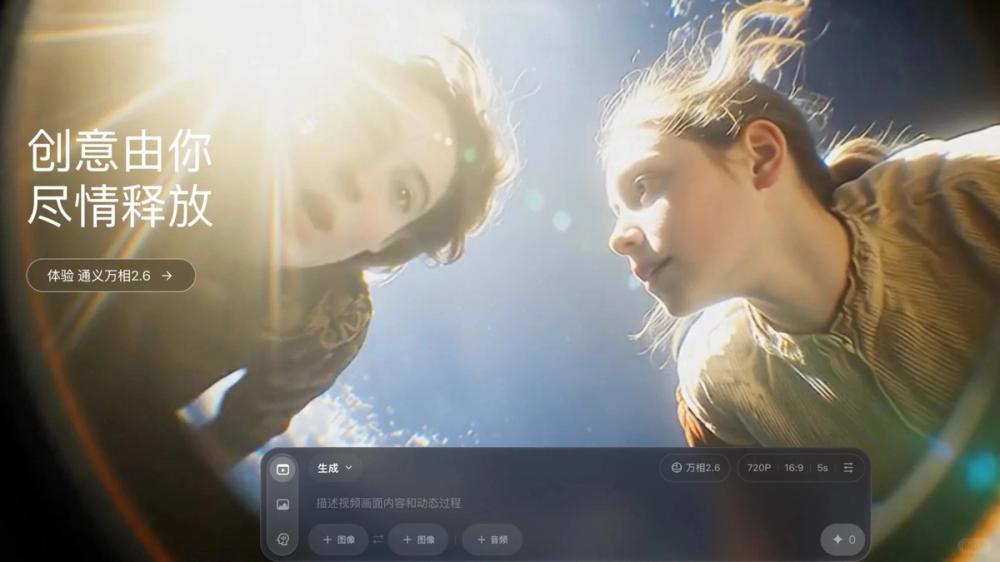
Third-Party Review: Wan 2.6 and the Rise of Role-Playing Video Generation
Alibaba’s newly released Wan 2.6 (万相 2.6) represents a significant milestone in the evolution of AI video generation. From a third-party perspective, this is not merely another incremental model update, but a clear signal that video generation in China is moving beyond experimental demos and into the territory of structured storytelling and professional-grade content creation.
The First True “Role-Playing” Video Model in China
What most clearly differentiates Wan 2.6 from previous video models is its role-playing capability. By allowing users to upload a short reference video and then generate new content in which the same character performs, speaks, and emotes consistently, Wan 2.6 goes far beyond face-swapping or style imitation. The model learns from the reference video itself—capturing appearance, motion patterns, expressions, and even vocal characteristics—then reuses them coherently in new scenes.
From an industry standpoint, this marks a shift from “generating visuals” to generating performances. That distinction is crucial for narrative-driven content such as short dramas, advertisements, and character-centric storytelling.
Professional-Level Storyboarding and Shot Control
Another standout feature is Wan 2.6’s multi-shot and storyboard control. The model can understand both natural language instructions and professional cinematic prompts, coordinating wide shots, close-ups, camera movements, and emotional pacing within a single video. Importantly, it maintains consistency across shots—characters remain recognizable, environments stay stable, and the overall tone does not drift.
This level of temporal and visual coherence has long been one of the hardest problems in AI video generation. Wan 2.6’s performance here suggests real progress toward aligning AI video models with actual film and TV production logic, rather than treating videos as isolated clips.
Sound-Driven, Audio-Visual Synchronization
Wan 2.6 also introduces a more advanced audio-visual joint modeling approach. Instead of simply attaching audio after video generation, the model allows sound—voice, emotion, pacing—to actively drive facial expressions, gestures, and scene rhythm. Dialogue scenes with multiple speakers are notably more stable, with natural lip-sync, expressive intonation, and improved vocal realism.
This “sound drives visuals” paradigm is especially important for dialogue-heavy formats like short dramas, interviews, and narrative ads, where emotional credibility depends heavily on audio-visual alignment.
Longer, More Usable Video Outputs
With support for up to 15 seconds of 1080p video per generation, Wan 2.6 reaches what many creators would consider a practical minimum for storytelling. While 15 seconds may sound modest, in the AI video domain it represents a meaningful balance between length, quality, and stability. The ability to maintain character identity and scene coherence across the full duration is arguably more important than raw length.
A Step Toward “Story Generation,” Not Just Video Generation
At a deeper level, Wan 2.6 reflects a broader industry transition. By jointly modeling visuals, audio, and narrative structure, the model moves AI video from generating fragments to generating stories. This lowers the barrier to entry for creators who lack traditional resources—cameras, crews, budgets—but possess strong ideas and storytelling instincts.
Overall Assessment
From a neutral, third-party viewpoint, Wan 2.6 stands out as one of the most complete and production-oriented video generation models currently available in China. Its strengths lie not in novelty alone, but in consistency, controllability, and narrative awareness. While it does not replace human filmmakers, it meaningfully reshapes who gets to participate in visual storytelling—and at what cost. For creators focused on short-form narrative content, Wan 2.6 sets a new and credible benchmark.


