

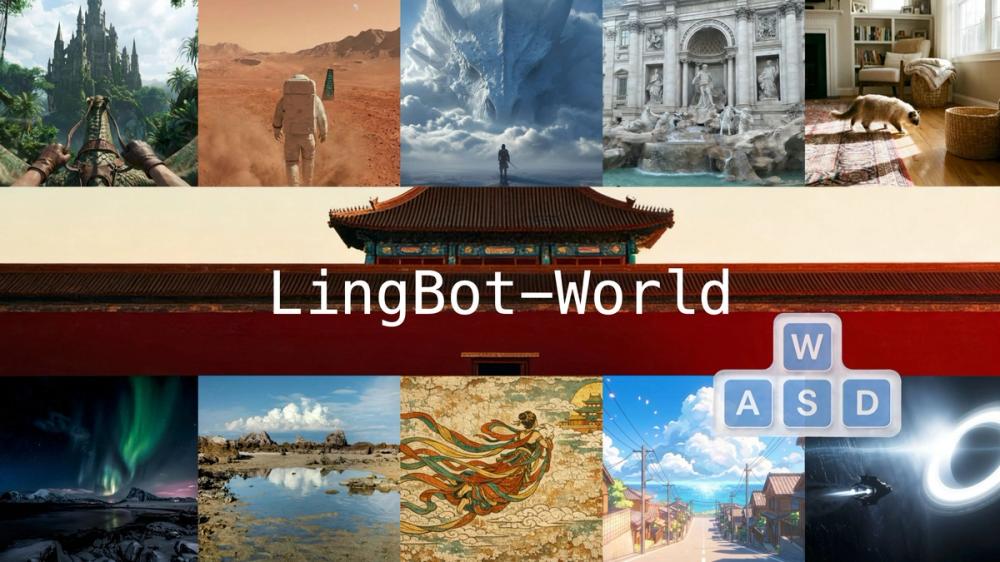
LingBot-World: An Open Frontier for Interactive World Models
LingBot-World is an open-source framework purpose-built for interactive world modeling. Unlike conventional video generation systems that passively synthesize frames, LingBot-World learns to simulate, remember, and reason about dynamic environments. At its core is LingBot-World-Base, a high-fidelity, controllable world simulator capable of maintaining logical and physical consistency over long time horizons.
This system represents a shift from visual generation toward causal world simulation—a foundational capability for embodied intelligence and advanced robotics.
From Video Synthesis to World Simulation
Most generative video models operate by predicting the next frame based on appearance patterns. While visually convincing, these systems often suffer from:
- Object inconsistency across time
- Violations of physical laws (e.g., clipping, teleportation)
- Lack of memory when objects leave the frame
- No capacity for interaction or action-conditioning
LingBot-World moves beyond these limitations by learning physics, causality, and spatial logic from large-scale interactive environments. Rather than modeling pixels, it models world dynamics.
Scalable Data Engine: Learning from Infinite Game Worlds
A key innovation behind LingBot-World is its proprietary Scalable Data Engine, which treats game engines as effectively infinite data generators.
Game worlds provide:
- Perfect physics engines
- Rich agent-environment interactions
- Controllable diversity of scenes and events
- Structured cause-and-effect relationships
By training on massive gameplay trajectories, LingBot-World learns the underlying rules that govern environments. Crucially, the model unifies the logic of physical and game worlds, enabling strong generalization from synthetic simulation to real-world scenarios.
High-Fidelity Simulation with Precise Control
LingBot-World supports fine-grained, action-conditioned generation. Instead of producing random or hallucinated sequences, the model responds directly to user or agent commands, generating physically plausible scenes that evolve according to those inputs.
This allows:
- Controllable scene generation
- Action-driven environment evolution
- Interactive simulation rather than passive playback
The result is a system that behaves more like a world engine than a video model.
Long-Horizon Consistency and Contextual Memory
One of the defining capabilities of LingBot-World is its ability to maintain minute-long structural and narrative coherence.
With enhanced contextual memory, the model preserves:
- Object permanence
- Scene structure
- Agent trajectories
- Logical continuity over time
Environments do not reset when out of view. Instead, they progress naturally, preserving the integrity of the simulated world.
Emerging Capabilities Beyond Generation
As LingBot-World scales, it demonstrates behaviors indicative of genuine world understanding:
Dynamic Off-Screen Memory
The model tracks agents and objects even when they leave the camera view. When the perspective returns, the world has advanced in a logically consistent way rather than freezing in place.
Exploring the Generation Boundary
LingBot-World sustains ultra-long, stable simulations without degradation, pushing the limits of temporal coherence in generative modeling.
Grounded Physical Constraints
The system enforces realistic collision dynamics and spatial logic. Agents cannot pass through walls, ignore obstacles, or violate physical constraints—behaviors that distinguish simulation from hallucination.
Modeling Both Physical and Game Worlds
By learning from synthetic environments with true physics and structured interactions, LingBot-World captures principles that transfer to real-world understanding:
- Spatial reasoning
- Temporal persistence
- Causal interaction
- Physical constraint awareness
This dual grounding allows the model to serve as a bridge between simulation environments and embodied agents operating in the physical world.
Implications for Robotics and Embodied AI
LingBot-World provides a foundation for:
- Training embodied agents in rich simulated environments
- Planning and reasoning over long action horizons
- Understanding cause-and-effect before acting in the real world
- Reducing reliance on costly real-world data collection
For robotics, this represents a crucial step toward systems that can simulate before acting, predict before moving, and reason about consequences in complex environments.
Conclusion
LingBot-World reframes generative modeling as interactive world modeling. Through scalable training on game environments, long-horizon memory, physical consistency, and action-conditioned control, it establishes a new paradigm: AI systems that do not merely generate images or videos, but simulate coherent worlds.
As an open-source framework, LingBot-World opens a new frontier for researchers and developers seeking to build the next generation of embodied intelligence, robotics, and world-aware AI systems.


