

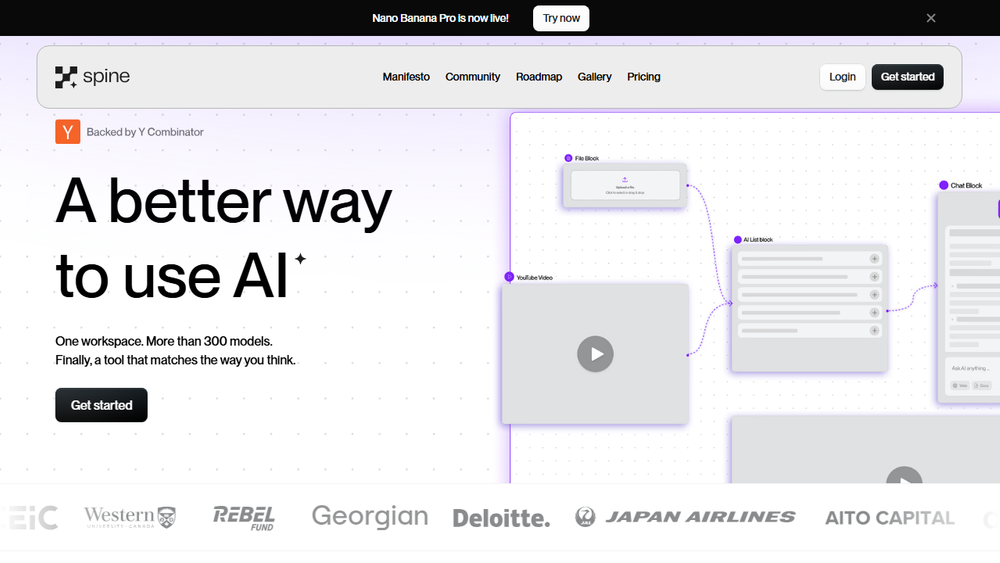
Spine AI is a cutting-edge platform designed to revolutionize how individuals and teams interact with and leverage Artificial Intelligence. More than just a chat interface, Spine AI offers a comprehensive visual workspace that empowers users to explore, iterate, branch, and ultimately manifest their ideas. This innovative approach is particularly beneficial for those working with AI, providing a structured and intuitive environment for complex projects.
The core philosophy behind Spine AI is to bridge the gap between conceptualization and execution in AI-driven workflows. Users can visualize their AI models, data pipelines, and experimental branches, fostering a deeper understanding and control over their AI projects. This visual paradigm simplifies the often intricate nature of AI development, making it accessible to a wider audience, from seasoned AI researchers to creative professionals looking to integrate AI into their work.
Key features of Spine AI include:
- Visual Workspace: A dynamic and interactive canvas where users can map out their AI projects, connect different components, and visualize the flow of information and processes. This allows for a holistic view of the AI ecosystem being developed.
- Iteration and Branching: The platform supports robust version control and branching capabilities, mirroring software development best practices. This enables users to experiment with different AI models, parameters, or datasets without disrupting their main project, facilitating rapid iteration and A/B testing.
- Idea Manifestation: Spine AI aims to transform abstract ideas into tangible AI applications. The visual workspace acts as a blueprint, guiding users through the development process and helping them to bring their AI concepts to life.
- AI-Centric Design: The entire platform is built with AI in mind, offering specialized tools and functionalities tailored to the unique needs of AI development, research, and deployment. This includes features for data management, model training, evaluation, and deployment.
- Collaboration: While not explicitly detailed in the provided snippet, visual workspaces often lend themselves well to collaborative efforts, allowing teams to work together on complex AI projects, share insights, and track progress effectively.
Spine AI targets a diverse range of users, including:
- AI Developers and Engineers: Providing a more intuitive and visual way to manage complex AI projects, experiment with different architectures, and deploy models.
- Data Scientists: Enabling them to visualize data pipelines, model performance, and experimental results in a clear and organized manner.
- Researchers: Offering a platform to document, share, and iterate on AI research, fostering collaboration and accelerating discovery.
- Creative Professionals: Allowing artists, designers, writers, and other creatives to explore the potential of AI in their respective fields, using AI as a tool for ideation and creation.
- Product Managers and Project Leads: Giving them oversight of AI development processes, enabling better communication and decision-making.
The platform's emphasis on a visual, iterative, and branching approach suggests it is well-suited for complex AI tasks such as machine learning model development, natural language processing projects, computer vision applications, and generative AI explorations. By providing a structured yet flexible environment, Spine AI aims to democratize AI development and empower users to unlock the full potential of artificial intelligence.


