

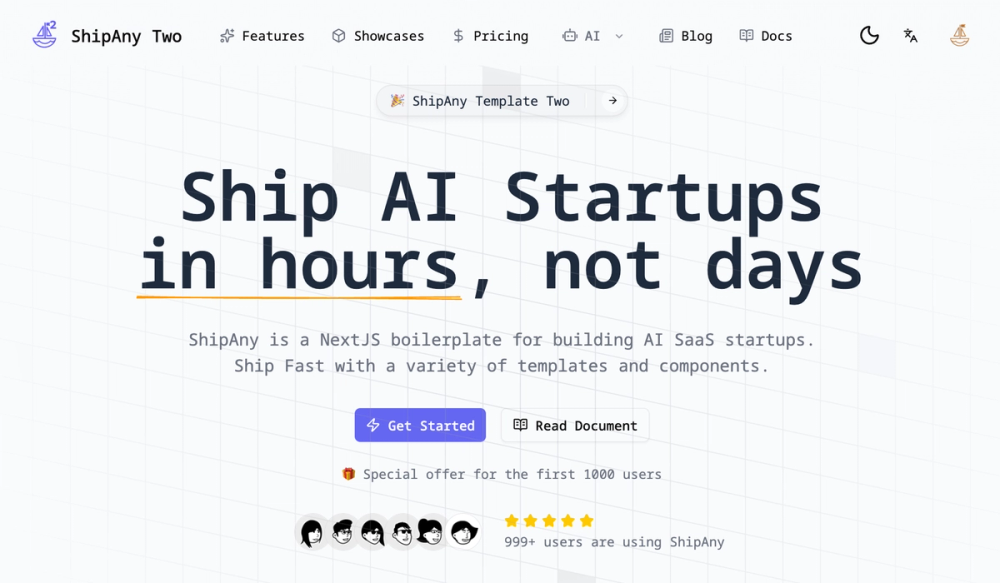
A Practical Review of ShipAny.ai: A Template for Building AI SaaS Products
ShipAny.ai is a website and development template aimed at developers and founders who want to build AI-powered SaaS products more efficiently. Rather than positioning itself as a no-code tool or a fully managed platform, ShipAny.ai presents itself as a practical boilerplate: a structured starting point that includes many of the components commonly required in modern SaaS applications.
This article reviews ShipAny.ai from a third-party perspective. It focuses on what the template offers, who it is suitable for, and what kinds of trade-offs users should be aware of. The goal is not to promote the product aggressively, but to provide a realistic and balanced overview.
What ShipAny.ai Is Designed For
ShipAny.ai is designed for people who already have a product idea but do not want to repeatedly rebuild the same technical foundations. In most SaaS projects, a large portion of early development time is spent on tasks such as authentication, basic UI layouts, payment integration, admin dashboards, and deployment configuration. ShipAny.ai attempts to bundle these recurring needs into a reusable template.
The target audience appears to be:
- Independent developers
- Solo founders
- Small startup teams
- Technical creators building AI-related tools or services
It is not aimed at complete beginners with no coding experience, nor is it intended to replace custom engineering for large or complex systems. Instead, it sits in the middle ground: offering structure and convenience while still expecting the user to write and modify code.
Core Philosophy
The core philosophy behind ShipAny.ai seems to be speed without abstraction overload. Instead of hiding infrastructure behind visual editors or proprietary systems, it relies on common web technologies and patterns that many developers already know.
This approach has a few implications:
- You can inspect and modify everything
- You are not locked into a closed ecosystem
- You are responsible for understanding the code you ship
For developers who value transparency and control, this is often preferable to tools that trade flexibility for simplicity.
Technical Stack and Structure
ShipAny.ai is built around a modern JavaScript stack. While the exact implementation details may evolve, the overall structure follows patterns that are widely used in contemporary SaaS development.
Typical characteristics include:
- A React-based frontend
- Server-side rendering or hybrid rendering
- A modular component system
- Environment-based configuration
- Support for modern deployment platforms
Because the stack is familiar, onboarding tends to be easier for developers who already work in the React or Next.js ecosystem. At the same time, developers unfamiliar with this stack should expect a learning curve.
Included Features and Modules
One of the main selling points of ShipAny.ai is the breadth of features included out of the box. While not every project will use every module, having them available can reduce setup time significantly.
User Authentication
Most SaaS products need user accounts. ShipAny.ai includes authentication logic that can be adapted to common workflows such as sign-up, login, and session handling. This removes the need to wire authentication from scratch for every project.
Payments and Monetization
Payment integration is another common pain point for early-stage products. ShipAny.ai provides a structured way to add paid plans or usage-based monetization. While customization is still required, the foundation is already in place.
Admin and Dashboard Interfaces
Internal dashboards for managing users, content, or settings are often neglected early on and then added later at significant cost. ShipAny.ai includes basic admin and dashboard layouts that can be extended as needed.
AI-Oriented Features
As the name suggests, ShipAny.ai is oriented toward AI-related products. This includes patterns and placeholders for integrating AI APIs or services. The template does not limit you to a specific provider, which helps avoid vendor lock-in.
Marketing and Landing Pages
The template includes landing page structures designed to present a SaaS product clearly. These are useful for early validation, waitlists, or public launches.
Templates and Use Case Coverage
ShipAny.ai also provides multiple example templates tailored to specific types of products. These examples serve two purposes:
- They demonstrate how the core framework can be adapted
- They reduce decision fatigue for new projects
Common template themes include AI tools, content generation platforms, and simple SaaS dashboards. Even if a template is not used directly, it can act as a reference implementation.
Setup and Developer Experience
From a developer’s perspective, setup appears straightforward for anyone familiar with JavaScript tooling. The process generally involves:
- Installing dependencies
- Configuring environment variables
- Running a local development server
- Deploying to a cloud platform
The experience is closer to working with a typical open-source project than using a hosted builder. This makes ShipAny.ai suitable for developers who prefer working locally and maintaining full control over their codebase.
Deployment and Hosting
ShipAny.ai is designed to be deployable on common hosting platforms used by modern web developers. This includes platforms that support serverless or hybrid rendering models.
Because the template does not enforce a specific hosting provider, teams can choose infrastructure that aligns with their budget, region, or scaling needs.
Pricing and Value Considerations
ShipAny.ai is a paid product. Its pricing reflects the time saved by not having to assemble and maintain a similar setup independently.
Whether the price is justified depends largely on your situation:
- If you build SaaS products regularly, the cost may be small compared to the time saved
- If you are experimenting casually or learning, the price may feel high
- If your project diverges heavily from typical SaaS patterns, you may use only part of the template
As with most boilerplates, its value increases when reused across multiple projects.
Strengths
ShipAny.ai has several strengths worth noting:
- Clear focus on SaaS fundamentals
- Modern and familiar tech stack
- Reasonable balance between structure and flexibility
- Emphasis on real-world product needs
- Suitable for both prototypes and early production use
It does not attempt to reinvent development workflows, which can be a strength in itself.
Limitations and Trade-Offs
No template fits every project. Some limitations to consider include:
- You still need to understand the code
- Customization beyond the defaults requires effort
- Documentation may not cover every edge case
- New users may feel overwhelmed by the number of features
These are typical trade-offs for any non-trivial boilerplate.
Who ShipAny.ai Is Best Suited For
ShipAny.ai is best suited for developers who:
- Want to launch an AI SaaS product quickly
- Are comfortable working with modern web stacks
- Prefer ownership of their codebase
- Plan to monetize their product
- Expect to iterate rapidly
It is less suitable for users looking for no-code solutions or fully managed platforms.
Final Evaluation
ShipAny.ai is a practical tool rather than a flashy one. Its value lies in reducing repetitive work and providing a solid starting point for SaaS development. It does not remove the need for engineering decisions, but it narrows the scope of those decisions in a helpful way.
For developers and founders who want to move faster without giving up control, ShipAny.ai is a reasonable option worth considering.
As with any foundational tool, the best way to evaluate it is to compare the cost of adoption against the time and complexity it saves in your specific context.
This article is written from an independent review perspective and reflects an analysis of the product’s positioning, structure, and intended use cases.


