

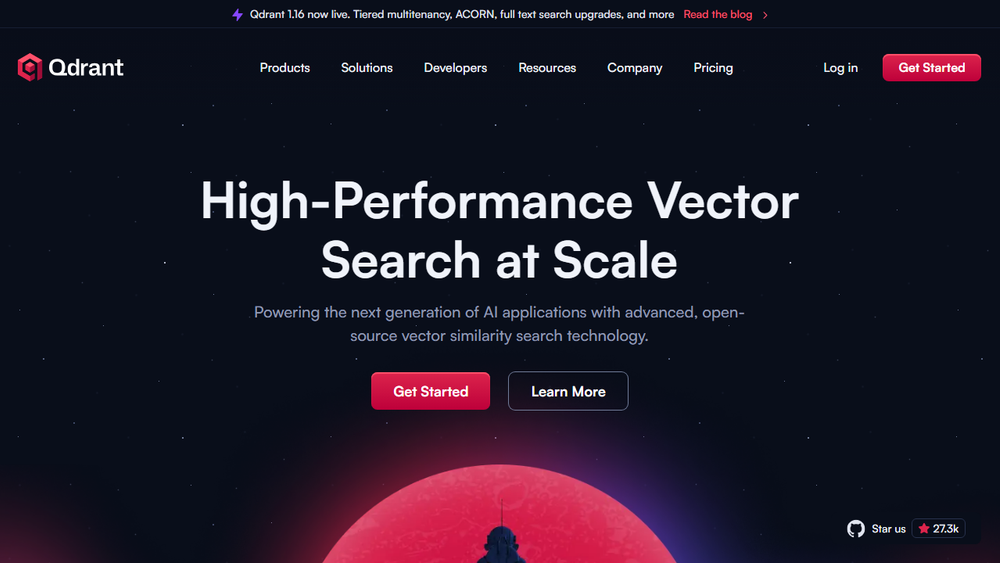
Qdrant is a high-performance, open-source vector database and vector search engine written in Rust. It is designed to provide fast and scalable vector similarity search services with a convenient API, making it an ideal solution for powering the next generation of AI applications. Qdrant excels in scenarios requiring efficient retrieval of similar items based on their vector embeddings, such as recommendation systems, image search, natural language processing tasks, anomaly detection, and AI agent development.
Core Features:
- High Performance: Built with Rust, Qdrant offers exceptional speed and efficiency for indexing and searching large volumes of vector data. Its architecture is optimized for low latency and high throughput.
- Scalability: Qdrant is designed to scale horizontally, allowing it to handle massive datasets and high query loads. It supports distributed deployments for enterprise-grade scalability.
- Vector Similarity Search: At its core, Qdrant provides advanced algorithms for approximate nearest neighbor (ANN) search, including Hierarchical Navigable Small Worlds (HNSW), enabling rapid discovery of similar vectors.
- Flexible Data Management: Supports rich filtering capabilities alongside vector search, allowing users to combine semantic similarity with traditional metadata filtering for more precise results.
- Convenient API: Offers a user-friendly REST API and gRPC API, along with client libraries for various programming languages, simplifying integration into existing applications.
- Open Source: As an open-source project, Qdrant fosters a vibrant community and allows for transparency, customization, and cost-effectiveness.
- Cloud and Enterprise Solutions: Beyond the open-source offering, Qdrant provides managed cloud services and enterprise solutions for businesses requiring dedicated support, advanced features, and enhanced security.
Target Users:
Qdrant is suitable for a wide range of users, including:
- AI/ML Engineers: For building and deploying AI-powered applications that rely on vector embeddings for search, recommendations, and analysis.
- Data Scientists: To efficiently store, index, and query large vector datasets for research and experimentation.
- Software Developers: To integrate powerful vector search capabilities into their applications with ease.
- Startups and Enterprises: Seeking a scalable, performant, and cost-effective vector database solution for their AI initiatives.
Use Cases:
Qdrant powers a variety of AI-driven use cases:
- Recommendation Systems: Finding similar products, content, or users based on their embeddings.
- Image and Multimedia Search: Enabling users to search for images, videos, or audio based on visual or acoustic similarity.
- Natural Language Processing (NLP): Powering semantic search, question answering, text classification, and document similarity.
- Anomaly Detection: Identifying unusual patterns or outliers in data by analyzing vector representations.
- AI Agents: Providing memory and retrieval capabilities for conversational AI and autonomous agents.
- RAG (Retrieval-Augmented Generation): Enhancing LLM responses by retrieving relevant context from a vector database.
Qdrant's commitment to performance, scalability, and developer experience makes it a leading choice in the rapidly evolving landscape of vector databases.


