

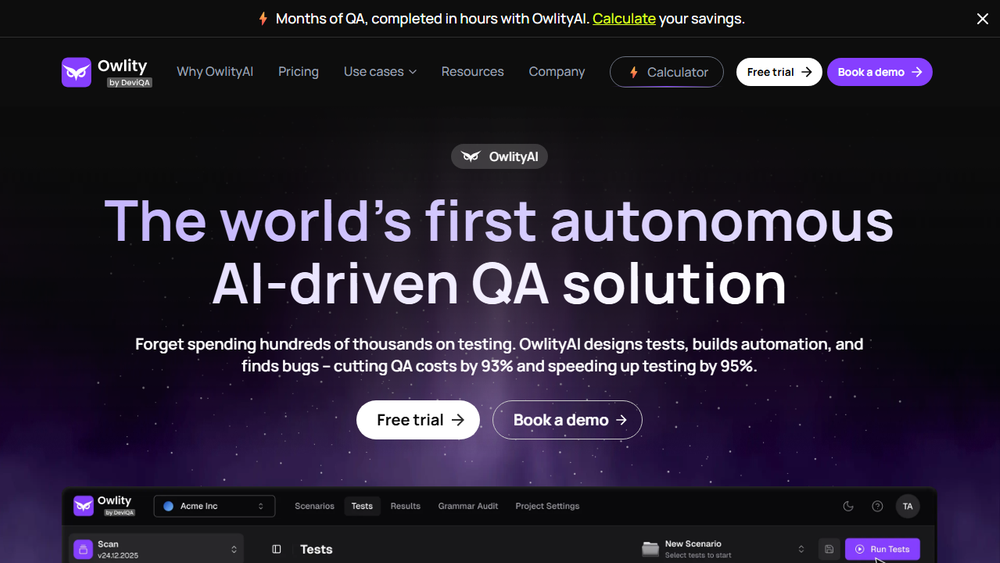
OwlityAI presents itself as a revolutionary solution in the realm of Quality Assurance (QA) testing, aiming to completely replace human QA departments with its advanced AI capabilities. The platform emphasizes its ability to automate the entire QA process, from test design and automation to bug detection, thereby drastically reducing operational costs and accelerating testing timelines.
Core Features:
- Autonomous Testing: OwlityAI's AI-driven software operates autonomously, eliminating the need for human involvement in the testing lifecycle. This includes designing tests, building automation scripts, and identifying bugs without manual intervention.
- Cost Reduction: The service claims to cut QA costs by an impressive 93%, making it a highly cost-effective alternative to traditional QA teams.
- Speed Enhancement: OwlityAI boasts a 95% speed increase in testing, allowing businesses to release products faster and more efficiently.
- Computer Vision for UI Understanding: The platform utilizes computer vision to scan applications, understand their User Interface (UI), and initiate testing instantly, ensuring comprehensive coverage.
- Automated Test Scenario Generation: OwlityAI generates complete test scenarios, moving beyond manual checklists and guesswork to provide smarter and faster testing solutions.
- Instantaneous Bug Detection: The AI is designed to find bugs efficiently, streamlining the debugging process.
Target Users:
OwlityAI is targeted towards businesses of all sizes that are looking to optimize their QA processes, reduce expenses, and accelerate their product development cycles. This includes startups, established enterprises, and software development companies that are struggling with the high costs and time commitments associated with traditional QA methods. The promise of replacing an entire QA department makes it particularly attractive to organizations seeking radical efficiency gains.
Value Proposition:
The primary value proposition of OwlityAI lies in its ability to deliver a superior, faster, and significantly cheaper QA solution compared to conventional approaches. By leveraging artificial intelligence, the platform aims to democratize high-quality QA testing, making it accessible and affordable for a wider range of businesses. The emphasis on "autonomous" testing suggests a future where software quality is maintained and improved without the need for human oversight in the testing phase, allowing human resources to be redirected to more strategic or creative tasks.


