

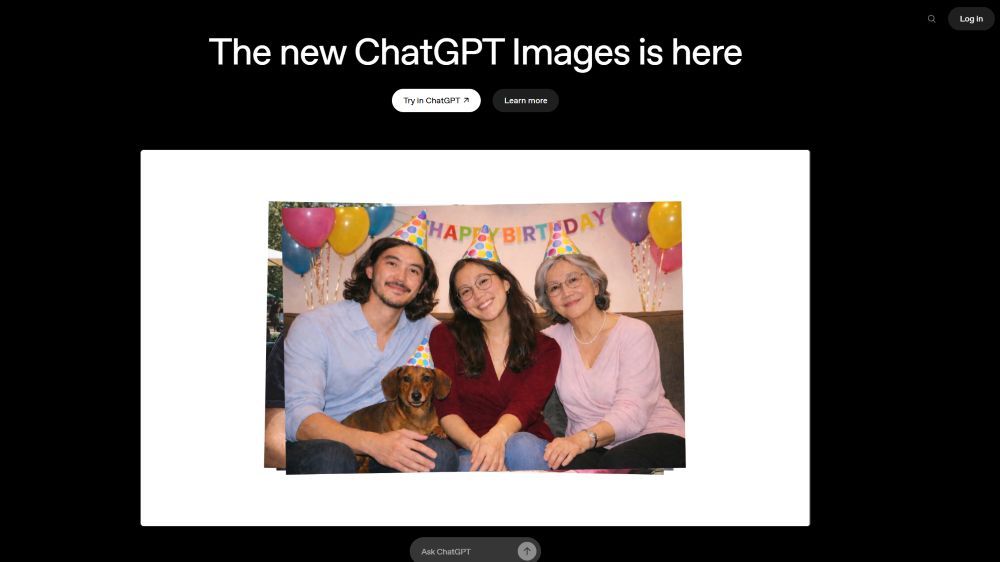
Who is better? GPT Image 1.5 vs. Nano Banana Pro
OpenAI’s release of GPT Image 1.5 arrives quickly after GPT-5.2, signaling that the company is under no illusion about the intensity of the current image-generation race. Positioned as a focused upgrade rather than a generational leap, GPT Image 1.5 directly confronts Nano Banana Pro, Google’s latest and arguably most refined image model to date. From a third-party evaluation perspective, the comparison reveals meaningful progress from OpenAI—yet also highlights where Google continues to set the pace.
What GPT Image 1.5 Improves
The most obvious gains in GPT Image 1.5 are instruction adherence and editing precision. Compared with GPT Image 1.0, the new model is noticeably more reliable when following targeted modification prompts, such as altering hairstyles, facial features, or scene attributes without destroying the original structure. Detail retention during edits has also improved, and generation speed—reported to be up to four times faster—makes iterative workflows far more practical.
The introduction of a dedicated image interface in ChatGPT further reinforces OpenAI’s intent to treat image generation as a first-class creative tool rather than a secondary feature. From a usability standpoint, this is a meaningful step toward professional adoption.
Where Nano Banana Pro Still Leads
Despite these advances, Nano Banana Pro continues to demonstrate stronger performance in photorealism, lighting, and spatial realism. In side-by-side comparisons, Banana Pro more consistently respects perspective rules such as depth, scale, and camera distance. Clothing lighting and shadow behavior, in particular, appear more physically grounded, while character proportions feel more natural across complex scenes.
This advantage becomes especially visible in compositions involving multiple subjects and foreground-background relationships, where GPT Image 1.5 occasionally flattens spatial hierarchy or misjudges relative scale.
Mixed Results in Knowledge and Detail Accuracy
Interestingly, the two models trade wins in more complex scenarios. In tasks involving world knowledge and cross-style transformations—such as changing time of day, weather, or artistic style—GPT Image 1.5 sometimes demonstrates better conceptual alignment. For example, clock faces and time-related details are more often logically correct, even if anatomical errors (such as incorrect finger counts) still occur.
Conversely, Nano Banana Pro occasionally stumbles in these knowledge-heavy cases, despite excelling visually. This suggests that while Banana Pro leads in visual realism, GPT Image 1.5 remains competitive in semantic reasoning tied to imagery.
The Broader Competitive Context
The release cadence itself tells an important story. GPT Image 1.5 is a cautious, incremental upgrade—perhaps intentionally avoiding the expectations implied by a “2.0” label. In contrast, Google’s Gemini 2.5 image pipeline has evolved at a striking pace, moving from early iterations to Banana, and then Banana Pro, in roughly six months. That velocity is difficult to ignore.
Final Verdict
From a neutral third-party standpoint, GPT Image 1.5 is a solid and necessary improvement, but not a decisive comeback. It narrows the gap in instruction following and usability, yet still trails Nano Banana Pro in realism, lighting, and spatial coherence. At present, Google appears to hold the technical edge, while OpenAI shows signs of regrouping. The competition is far from over—but for now, GPT Image 1.5 feels more like a response than a breakthrough.


