

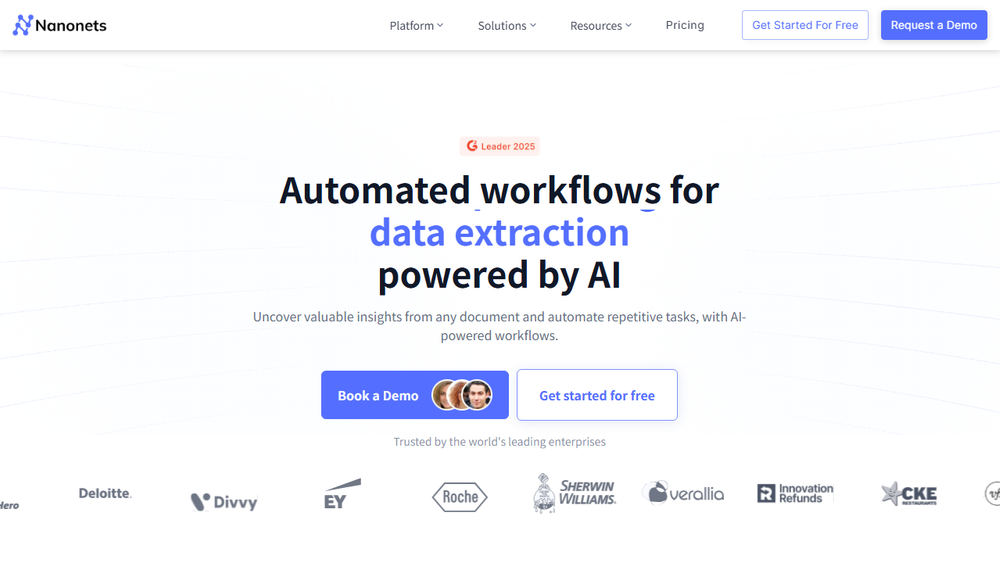
Nanonets is a cutting-edge platform designed to revolutionize how businesses handle document-heavy processes through advanced AI and automation. It specializes in Intelligent Document Processing (IDP), enabling businesses to automatically extract data from various document types, thereby significantly reducing manual effort and accelerating workflows. The core of Nanonets' offering lies in its powerful AI models that can understand, classify, and extract information from unstructured and semi-structured documents with remarkable accuracy.
Core Features:
- AI-Powered Data Extraction: Nanonets utilizes state-of-the-art machine learning and deep learning algorithms to accurately extract data from a wide range of documents, including invoices, purchase orders, bills of lading, passports, ID cards, bank statements, and receipts. This capability eliminates the need for manual data entry, a common bottleneck in many business operations.
- Automated Workflows: Beyond just extraction, Nanonets facilitates the creation of end-to-end automated workflows. This includes setting up rules for document routing, approvals, data validation, and integration with existing business systems. This feature is crucial for optimizing processes like accounts payable, order processing, and insurance underwriting.
- Customizable Models: Recognizing that every business has unique document types and data requirements, Nanonets offers the flexibility to train custom AI models. This ensures that the platform can be tailored to specific industry needs and internal document formats, maximizing relevance and accuracy.
- OCR and Document Understanding: The platform leverages advanced Optical Character Recognition (OCR) technology combined with natural language processing (NLP) to not only read text but also understand the context and meaning of the information within documents.
- Scalability and Integration: Nanonets is built to scale with business growth, handling large volumes of documents efficiently. It also offers robust integration capabilities, allowing seamless connection with popular ERP, CRM, and other business software through APIs, ensuring that extracted data flows smoothly into existing operational ecosystems.
- Industry-Specific Solutions: The platform provides tailored solutions for various industries, including finance and accounting, supply chain and operations, human resources, customer support, legal, banking, insurance, and healthcare. This industry-specific focus allows businesses to leverage Nanonets for their most critical document-centric challenges.
- AI Agents: Nanonets is expanding its capabilities with AI Agents, offering advanced automation and intelligence for complex tasks.
Target Users:
Nanonets is designed for a broad spectrum of businesses, from small and medium-sized enterprises (SMEs) to large enterprises, that deal with significant volumes of documents. Key users include:
- Finance and Accounting Departments: For automating invoice processing, accounts payable, expense management, and financial reconciliation.
- Operations and Supply Chain Teams: For streamlining order processing, managing shipping documents, and optimizing logistics workflows.
- Human Resources: For automating the processing of employee onboarding documents, payroll information, and HR forms.
- Customer Support: For extracting information from customer inquiries, feedback forms, and support tickets.
- Legal Departments: For managing contracts, legal documents, and compliance-related paperwork.
- Insurance Companies: For automating claims processing, underwriting, and policy management.
- Healthcare Providers: For processing patient records, medical forms, and billing information.
By automating repetitive, time-consuming, and error-prone tasks associated with document handling, Nanonets empowers organizations to improve efficiency, reduce operational costs, enhance data accuracy, and free up valuable human resources to focus on more strategic initiatives. The platform's commitment to continuous AI development ensures that businesses can stay ahead of the curve in digital transformation.


