

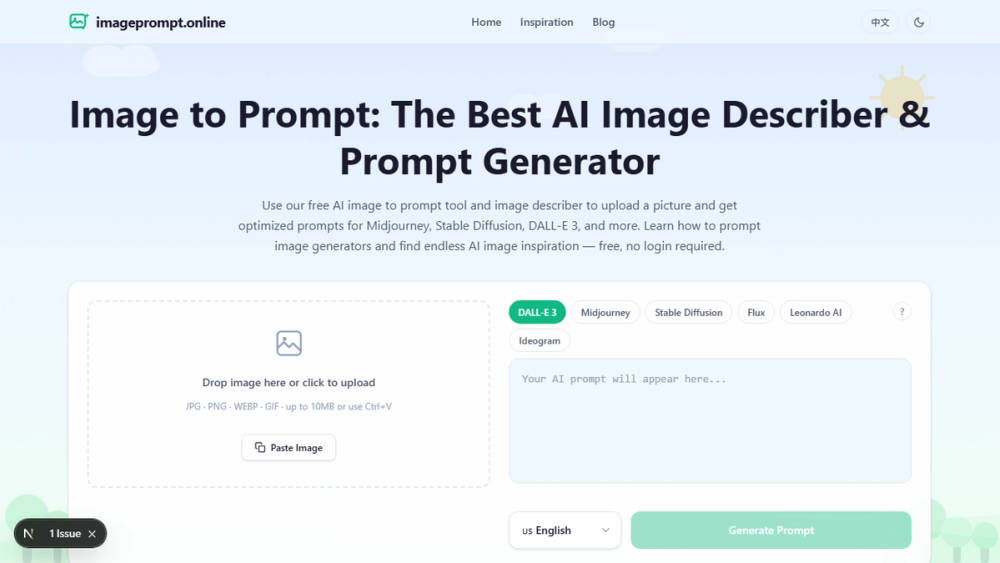
Unleash Your Creative Vision with imageprompt.online: The Ultimate AI Image to Prompt Generator
In the rapidly evolving landscape of AI-generated art, the ability to translate visual concepts into precise, effective prompts is paramount. imageprompt.online emerges as a revolutionary tool, empowering users to transform any image into a detailed, model-specific AI prompt. Whether you're a seasoned AI artist looking to replicate a specific aesthetic or a beginner curious about the intricacies of prompt engineering, this platform offers an intuitive and powerful solution. It bridges the gap between visual inspiration and the text-based commands that drive cutting-edge AI image generation models.
Core Functionality: From Pixels to Prompts
The primary function of imageprompt.online is to analyze an uploaded image and generate a descriptive text prompt that can be used with various AI image generation models. This process involves sophisticated AI algorithms that go beyond simple object recognition. The tool aims to capture the essence of the image, including:
- Artistic Style: Identifying whether the image is a photograph, illustration, painting, 3D render, or a specific artistic movement (e.g., Impressionism, Cyberpunk, Anime).
- Composition and Framing: Analyzing camera angles, shot types (close-up, wide shot), and the overall arrangement of elements within the frame.
- Lighting and Atmosphere: Detecting the type of lighting (e.g., golden hour, volumetric, neon), mood, and environmental conditions (e.g., rain, fog, clear sky).
- Color Palette: Recognizing dominant colors, color grading, and the overall color harmony or contrast.
- Subject Details: Describing the main subjects, their attributes, clothing, expressions, and interactions.
- Technical Details: Inferring details like lens type, depth of field, and rendering engine if applicable.
This comprehensive analysis allows the tool to generate prompts that are not only descriptive but also highly effective in guiding AI models to produce similar or inspired results.
Supported AI Models and Prompt Formats
imageprompt.online distinguishes itself by offering tailored prompt formats for a wide array of popular AI image generation models. This ensures that the generated prompts adhere to the specific syntax, keywords, and parameters that each model understands best. Currently supported models include:
- Midjourney (v6): Known for its artistic flair and often complex prompt structures, Midjourney prompts generated by the tool will leverage its unique parameters and stylistic keywords.
- DALL-E 3: Renowned for its ability to adhere closely to detailed prompts and its integration with ChatGPT, the prompts are optimized for clarity and specificity.
- Stable Diffusion (WebUI/ComfyUI): This open-source model offers immense flexibility. The generated prompts will be suitable for various Stable Diffusion interfaces, potentially including negative prompts and specific model-related keywords.
- Flux: A newer, powerful model that benefits from precise descriptive prompts.
- Leonardo AI: A popular platform offering various fine-tuned models, the prompts are geared towards its ecosystem.
- Ideogram: Particularly noted for its strength in generating text within images, prompts are crafted to leverage this capability.
- Nano Banana 2: A model highlighted for its anime and illustration capabilities, with prompts tailored to its aesthetic strengths.
By providing model-specific formats, imageprompt.online saves users the time and effort of manually adapting prompts, making the transition from inspiration to creation seamless.
Key Features and User Experience
Beyond its core functionality, imageprompt.online is designed with the user in mind, offering a suite of features that enhance usability and creative potential:
- Free to Use & No Login Required: The platform is accessible to everyone without the need for account creation, removing barriers to entry and encouraging experimentation.
- Fast and Efficient: The image-to-prompt conversion process is optimized for speed, allowing users to get results quickly.
- Intuitive Interface: The website features a clean, user-friendly design. Uploading an image is as simple as dragging and dropping or clicking to select a file. Pasting an image directly from the clipboard is also supported.
- URL Import: Users can also import images by pasting a direct URL, offering additional flexibility.
- Inspiration Gallery: A curated gallery showcases stunning AI-generated images with their corresponding prompts, serving as a valuable resource for learning and inspiration. Users can easily copy prompts or apply them directly to the generator.
- Blog and Tutorials: The platform hosts a blog with articles on prompt engineering, AI art trends, and tutorials, further educating users on how to maximize their creative output.
- Privacy Focused: The service explicitly states that uploaded images are processed temporarily in memory and are never saved or used for training, ensuring user privacy.
- Multi-language Support: The interface and prompts can be adapted for various languages, making the tool accessible to a global audience.
- Comparison Tool: A feature allows users to compare the strengths and weaknesses of different AI models, aiding in the selection of the best tool for a specific task.
Target Audience and Use Cases
imageprompt.online caters to a diverse range of users:
- AI Artists and Designers: Professionals seeking to replicate specific visual styles, moods, or compositions for their projects. They can use the tool to reverse-engineer existing artwork or find inspiration for new creations.
- Content Creators: Individuals looking to generate unique visuals for social media, blogs, websites, or marketing materials. The tool helps in crafting prompts that align with brand aesthetics or campaign themes.
- Hobbyists and Enthusiasts: Anyone interested in exploring the world of AI art generation, learning how to create compelling images, and understanding the relationship between prompts and outputs.
- Educators and Students: The platform serves as an excellent educational resource for learning about prompt engineering, AI art principles, and the capabilities of different AI models.
- Developers: While not explicitly stated as an API service in the public-facing content, the underlying technology could be of interest to developers looking to integrate image-to-prompt capabilities into their own applications.
Unique Selling Propositions (USPs)
Several factors make imageprompt.online stand out:
- Model-Specific Prompt Optimization: The ability to generate prompts tailored to the nuances of different AI models is a significant advantage over generic prompt generators.
- Comprehensive Image Analysis: The tool's depth in analyzing visual elements (style, lighting, composition) leads to more accurate and effective prompts.
- Free and Accessible: The no-login, free-to-use model democratizes access to advanced AI art tools.
- Educational Focus: The integrated blog, tutorials, and inspiration gallery empower users to become better prompt engineers.
- Privacy Assurance: A clear commitment to not saving user images builds trust.
Technical Underpinnings (Inferred)
While the exact technical stack is not detailed, the functionality suggests the use of advanced technologies:
- Computer Vision Models: For image analysis, object detection, style recognition, and feature extraction. Models like CLIP (Contrastive Language–Image Pre-training) or similar multimodal AI are likely involved.
- Large Language Models (LLMs): To process the extracted visual features and translate them into coherent, descriptive, and model-specific text prompts. Gemini Vision is mentioned in the FAQ, indicating its potential role.
- Web Technologies: A modern frontend framework (likely React, given the
_nextdirectory structure) for a dynamic and responsive user interface, coupled with a robust backend infrastructure to handle image processing and AI model interactions. - Cloud Infrastructure: Scalable cloud services would be necessary to manage the computational demands of image analysis and prompt generation, especially given the free tier and potential for high user traffic.
The Future of AI Art Prompting
Tools like imageprompt.online are at the forefront of democratizing AI art creation. By simplifying the complex process of prompt engineering, they enable a wider audience to harness the power of AI image generators. As AI models continue to advance, the need for sophisticated tools that can bridge the gap between human creativity and machine understanding will only grow. imageprompt.online is well-positioned to be a leading platform in this space, offering a blend of powerful technology, user-friendly design, and valuable educational resources.
Whether you aim to recreate a specific artistic style, generate variations of an existing image, or simply understand how to better communicate your visual ideas to AI, imageprompt.online provides the essential tools and knowledge to elevate your AI art journey. Its commitment to being free, accessible, and privacy-conscious further solidifies its value proposition in the competitive AI tool market.
Practical Applications and Workflow Integration
The utility of imageprompt.online extends across numerous practical applications:
- Replicating Artistic Styles: A user finds a painting with a unique Impressionist style. By uploading it to imageprompt.online, they can generate a prompt that captures the brushstrokes, color palette, and lighting characteristic of that style, allowing them to create similar original artworks.
- Generating Variations: An AI artist creates an image they like but wants to explore variations. Uploading the generated image back into imageprompt.online can yield prompts that capture its essence, enabling the generation of similar images with subtle differences or different compositions.
- Product Photography Enhancement: E-commerce businesses can use the tool to generate prompts for creating consistent product imagery. For example, uploading a product photo taken in a studio setting can result in a prompt that describes the lighting, background, and product details, allowing for the generation of multiple product shots with a unified aesthetic.
- Concept Art Development: Game developers or filmmakers can use reference images to generate prompts that describe specific moods, environments, or character designs, accelerating the concept art creation process.
- Learning Prompt Engineering: Beginners can upload images they admire and study the generated prompts to understand how specific visual elements are translated into keywords and parameters that AI models respond to. This is invaluable for learning how to prompt image generators effectively.
- Social Media Content Creation: Users can generate prompts for visually striking images to use on social media platforms, ensuring their content stands out. For example, uploading a vibrant travel photo could generate a prompt for similar scenic images.
- Personalized Art: Individuals can upload personal photos (e.g., a pet, a landscape) and generate prompts to create artistic interpretations or stylized versions of their memories.
The Technology Behind the Magic (Speculation)
The effectiveness of imageprompt.online hinges on sophisticated AI models. It's highly probable that the platform utilizes a combination of:
- Vision-Language Models (VLMs): Such as Google's Gemini Vision (as hinted in the FAQ), OpenAI's CLIP, or similar architectures. These models are trained to understand the relationship between images and text, enabling them to describe visual content in a way that is meaningful for text-to-image generation.
- Prompt Engineering Techniques: The system likely employs advanced prompt engineering strategies to translate the extracted visual features into structured prompts that align with the specific requirements of different AI models. This might involve keyword extraction, parameter tuning, and stylistic phrasing.
- Fine-tuned Models: For specific AI art models like Midjourney or Stable Diffusion, the system might use fine-tuned prompt structures or templates that have been empirically shown to yield the best results.
- Cloud-Based Processing: Image analysis and prompt generation are computationally intensive tasks. The platform likely leverages cloud computing resources (e.g., AWS, Google Cloud, Azure) to handle these demands efficiently and scale as needed.


