

A Deep-Dive Review of Next.js Agent Skills by Vercel Labs
An independent, third-party evaluation of the “Next.js Agent Skills” project and its implications for AI-assisted development workflows.
Executive Summary
As AI coding assistants mature, a subtle but increasingly critical challenge has emerged: LLMs do not inherently understand framework-specific architectural constraints. While they can produce syntactically valid React or JavaScript, they frequently violate the nuanced rules that modern meta-frameworks like Next.js impose — especially in the era of React Server Components (RSC), Partial Prerendering (PPR), async server APIs, and Edge/Node runtime duality.
The Next.js Agent Skills project from Vercel Labs addresses this problem head-on.
Rather than teaching developers how to use Next.js, this project teaches AI agents how to correctly operate within Next.js. It encodes expert knowledge about file conventions, rendering boundaries, caching rules, metadata generation, route handlers, runtime selection, and migration strategy into a formalized skill layer that AI agents can automatically apply.
This is not documentation.
This is not a template.
This is not a plugin.
This is a behavioral training layer for AI coding agents.
And it may represent the most important missing piece in AI-assisted full-stack development.
The Problem This Project Solves
Anyone who has used an AI assistant to generate Next.js code has likely encountered patterns like:
- Importing client hooks into server components
- Mixing
use clientand server functions incorrectly - Misusing async patterns introduced in Next.js 15+
- Breaking RSC boundaries unintentionally
- Writing API routes incorrectly in
pages/apiinstead ofroute.ts - Producing hydration mismatch bugs
- Misusing
next/imageandnext/font - Generating metadata improperly for SEO
- Ignoring the Edge vs Node runtime differences
- Failing to use cache components or
use cachecorrectly in Next.js 16
These are not beginner mistakes.
These are structural violations of the Next.js execution model.
The reason is simple:
AI models are trained on general React patterns, not the operational contract of Next.js.
Next.js is no longer “just React with routing.”
It is a constrained execution environment with a strict set of architectural rules.
Next.js Agent Skills exists to encode those rules into AI behavior.
What “Agent Skills” Actually Means
This project follows the Agent Skills open standard, where a “skill” is:
A reusable, structured knowledge module that modifies how an AI agent reasons and generates code in a particular domain.
These skills are installed into an AI coding environment via:
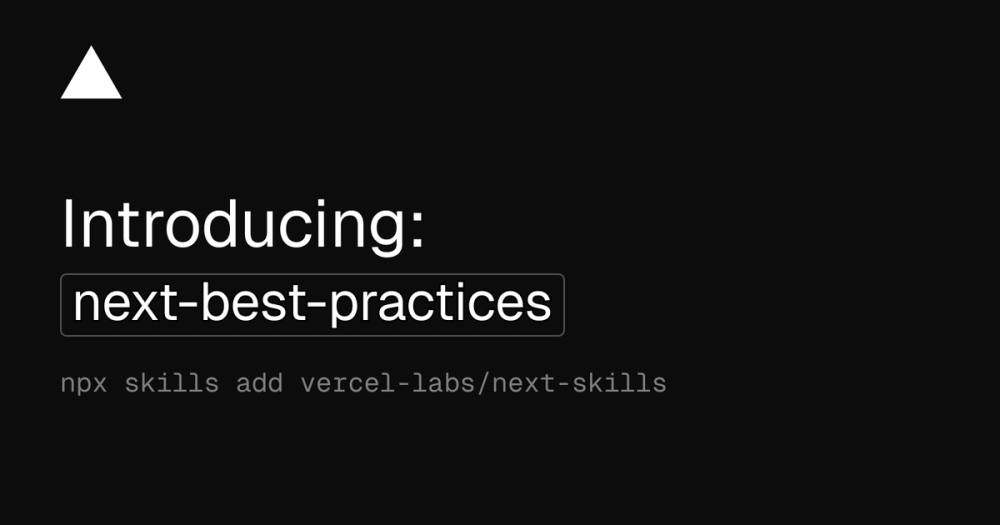
npx skills add vercel-labs/next-skillsOnce installed, the AI does not need prompting. The rules are automatically applied in the background.
This is the critical innovation:
The developer no longer needs to explain Next.js constraints to the AI.
The AI simply knows.
The Core Skill: next-best-practices
The foundational skill, auto-applied by default, is next-best-practices. It is effectively a codified operational manual for how Next.js should be used in 2026 and beyond.
It covers:
| Domain | What the Skill Enforces |
|---|---|
| File Conventions | Correct use of app/, layout.tsx, page.tsx, route.ts |
| RSC Boundaries | Prevents client/server mixing errors |
| Data Patterns | Correct fetching and mutation strategies |
| Async Patterns | Correct use of Next.js 15+ async APIs |
| Directives | Proper use of 'use client', 'use server', 'use cache' |
| Runtime Selection | Node.js vs Edge runtime awareness |
| Error Handling | Error boundaries, redirects |
| Metadata | SEO, OG images, sitemaps |
| Images & Fonts | Proper usage of next/image and next/font |
| Bundling | CSS imports, polyfills, package compatibility |
| Suspense & Hydration | Avoiding common mismatch pitfalls |
| Parallel Routes | Modal patterns, intercepting routes |
| Self-Hosting | Docker, standalone output, ISR |
| Debugging | MCP endpoints, selective rebuilds |
This is an astonishingly comprehensive list. It covers nearly every category where AI typically makes mistakes.
Optional Advanced Skills
Beyond the core skill, the project includes invocable skills for specific advanced scenarios.
/next-upgrade
This skill guides AI agents through official migration paths when upgrading Next.js versions. Instead of hallucinating migration steps, the agent follows Vercel’s official guides.
/next-cache-components
This is particularly forward-looking. It covers:
cacheComponents: true'use cache'cacheLife()cacheTag()updateTag()- Partial Prerendering (PPR)
These are Next.js 16 features that most public documentation — and most AI training data — does not yet handle correctly.
This skill effectively gives the AI future knowledge.
Why This Matters More Than It First Appears
This project is not about convenience.
It is about reliability.
Without skills, AI-generated Next.js code often requires a developer to:
- Detect architectural mistakes
- Understand why they are wrong
- Rewrite them manually
With skills, the AI produces structurally valid Next.js code by default.
The difference is not speed.
The difference is trust.
Architectural Insight: Teaching AI Framework Semantics
Most AI tooling focuses on:
“Generate code that looks correct.”
Next.js Agent Skills focuses on:
“Generate code that behaves correctly in this framework.”
This is a higher level of intelligence.
It is not syntax.
It is framework semantics.
And that is what LLMs fundamentally lack without help.
Practical Impact for Developers
For developers working with:
- React + Next.js App Router
- Server Components
- Edge runtime deployments
- ISR and PPR strategies
- Complex routing (parallel/intercepting)
- SEO-heavy sites
- Self-hosted Next.js (Docker, standalone)
This skillset eliminates entire categories of AI mistakes.
Especially for teams who:
- Rapidly scaffold features with AI
- Review AI-generated pull requests
- Use AI in pair-programming workflows
- Maintain large Next.js codebases
A Hidden Benefit: Enforcing Modern Patterns
An unexpected benefit is that this project forces AI to use modern Next.js patterns instead of outdated Pages Router examples still prevalent in training data.
It prevents:
pages/API routes- Legacy data fetching (
getServerSideProps) - Deprecated patterns
- Incorrect caching strategies
It silently upgrades AI output to current best practices.
Comparison to Traditional Documentation
Documentation tells humans what to do.
Agent Skills tells AI what to do.
This is the first serious example of framework documentation written for machines instead of people.
And that may be a preview of how all framework docs will evolve.
Integration with React Best Practices
The project also recommends pairing with:
npx skills add vercel-labs/agent-skills --skill react-best-practicesThis creates a layered intelligence:
- React correctness
- Next.js correctness
Which together produce AI output that is nearly production-ready.
Limitations and Considerations
While powerful, this system depends on:
- AI environments that support the Agent Skills standard
- Developers being aware of and installing the skills
- Ongoing maintenance as Next.js evolves
Additionally, this does not replace architectural thinking. It prevents mistakes, but does not design your system.
The Strategic Vision
This project hints at a future where:
Every major framework ships an AI skill pack alongside its documentation.
Instead of hoping AI learns from GitHub examples, frameworks will teach AI directly.
Next.js Agent Skills is likely the first of many.
Verdict
Next.js Agent Skills is one of the most strategically important developer tooling projects to emerge in the AI era.
It does not add features.
It does not change Next.js.
It changes how AI understands Next.js.
For teams using AI in serious Next.js development, this is not optional. It is foundational.
Who Should Use This Immediately
- Developers building with Next.js App Router
- Teams relying on AI code generation
- Engineers deploying to Edge runtimes
- Anyone upgrading to Next.js 15/16
- Self-hosting Next.js applications
- SEO-critical applications
- Complex routing architectures
Final Thoughts
We are entering an era where AI is part of the development team.
But AI is only as good as the rules it knows.
Next.js Agent Skills gives AI the rules.
And that changes everything.

