

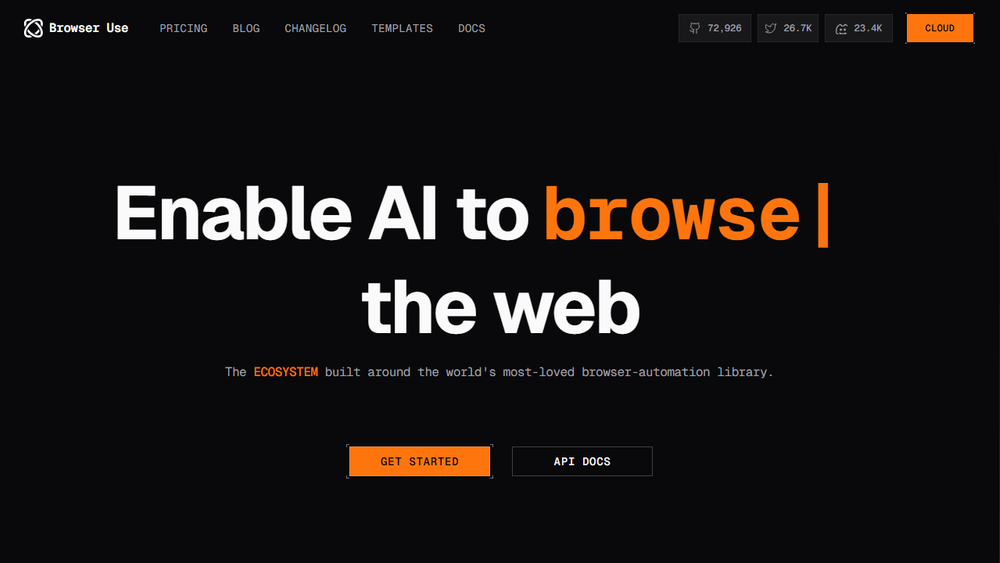
Browser Use is an ecosystem built around a powerful browser-automation library designed to enable AI to automate web interactions. It aims to provide a robust and user-friendly platform for developers and businesses looking to leverage AI for tasks such as data extraction, web scraping, automated testing, and more. The core of Browser Use is its library, which is described as the 'world's most-loved browser-automation library,' suggesting a strong community and extensive adoption.
Core Features and Capabilities:
- AI-Powered Automation: The primary focus is on enabling AI agents to navigate and interact with the web autonomously. This implies capabilities for understanding web page structures, making decisions based on context, and executing complex sequences of actions.
- Browser Automation Library: At its heart, Browser Use offers a library that simplifies the process of controlling web browsers programmatically. This likely includes features for launching browsers, navigating to URLs, interacting with elements (buttons, forms, links), extracting data, and handling various web scenarios.
- Ecosystem Approach: The term 'ecosystem' suggests that Browser Use is more than just a library. It likely encompasses tools, services, and community support that enhance the browser automation experience. This could include cloud-based solutions for running automations at scale, pre-built templates, and a marketplace for sharing or discovering automation scripts.
- Scalability and Reliability: For enterprise-level applications, scalability and reliability are crucial. Browser Use likely offers solutions that allow for running numerous automation tasks concurrently and ensuring consistent results.
- Developer-Friendly: The emphasis on a 'library' and 'ecosystem' points towards a developer-centric approach, providing APIs and tools that integrate well into existing development workflows.
Target Users:
- Developers: Individuals and teams building web applications, automation tools, or AI-powered services that require web interaction.
- Data Scientists and Analysts: Professionals who need to extract large amounts of data from websites for analysis and research.
- QA Engineers: Testers looking to automate repetitive testing processes for web applications.
- Businesses: Companies seeking to automate customer service, marketing tasks, lead generation, or internal processes that involve web interfaces.
- AI Researchers: Those developing and testing AI agents that need to interact with the real-world web.
Potential Use Cases:
- Web Scraping and Data Extraction: Gathering information from websites for market research, competitive analysis, or content aggregation.
- Automated Testing: Performing end-to-end testing of web applications to ensure functionality and identify bugs.
- Form Filling and Data Entry: Automating the process of submitting forms on various websites.
- Content Generation and Management: Automating the creation and posting of content on social media or blogs.
- Customer Support Automation: Building chatbots or AI assistants that can handle customer queries and tasks on websites.
- E-commerce Automation: Automating tasks like price monitoring, product listing, or order processing.
- Personalized Web Experiences: Creating AI agents that can tailor web content or interactions based on user preferences.
Browser Use positions itself as a comprehensive solution for anyone looking to harness the power of AI for web automation, offering a blend of a powerful library, a supportive ecosystem, and a focus on enabling intelligent web navigation.


