

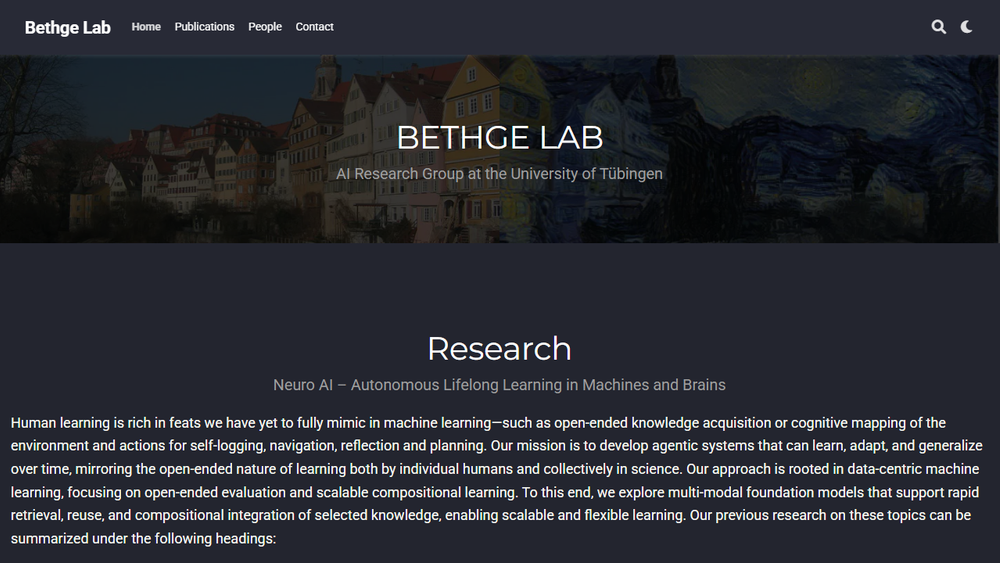
The Bethge Lab is a research group at the University of Tübingen dedicated to exploring the intersection of Artificial Intelligence and Neuroscience. Their primary focus is on understanding the computational principles underlying perception and learning in both biological and artificial systems. The lab investigates how complex neural networks, both in the brain and in machine learning models, solve intricate pattern recognition problems. A key area of their research involves developing AI agents capable of open-ended knowledge acquisition, lifelong learning, and cognitive mapping, aiming to mimic the adaptability and generalization abilities seen in human learning.
Their research is broadly categorized into several key themes:
Open-ended model evaluation & benchmarking: In an era where AI models are deployed on vast and evolving datasets, the lab emphasizes the need for robust and dynamic evaluation methods. They are developing new concepts and tools for lifelong benchmarking, aiming to democratize model assessment and ensure transparency. This research also explores how machine learning can be used beyond mere prediction to foster scientific understanding and continuous model building.
Language Model Agents: The group is working on developing AI systems that can engage in autonomous thinking, communication, and reasoning. These language model agents are envisioned to act as sophisticated assistants for tasks like theorem proving, automating scientific discovery, and aggregating information from the web to make informed predictions in uncertain environments.
Lifelong compositional, scalable and object-centric learning: Recognizing that human learning is inherently lifelong and compositional, the lab investigates how these principles can be applied to machine learning. They hypothesize that the object-centric nature of human perception is a crucial factor in scalable lifelong learning. Their work combines theoretical research on compositionality and object-centric perception with practical, scalable lifelong learning methods and benchmarks.
Modeling brain representations & mechanistic interpretability: The Bethge Lab develops machine learning models to analyze neural data and understand how biological neural populations perform inference and learning. They are particularly interested in the principles governing distributed processing in neural networks. This involves building and benchmarking digital twins of brain areas, such as the mammalian retina and visual cortex, and creating tools for interpreting and understanding neural representations and computations.
Attention in Humans and Machines: The lab studies human attention as a mechanism for active perception and inference, and explores its potential to improve attention mechanisms in machine learning. They build and benchmark models of human attention across various modalities, aiming to integrate these mechanisms into computer vision tasks and models of human behavior.
AI sciencepreneurship and startups: Beyond fundamental research, the Bethge Lab is also involved in translating their findings into practical applications. They explore how machine learning can be used to create economically viable solutions for real-world problems and actively collaborate with and spin off startups in the AI space.
The lab's broader impact extends to outreach initiatives like the Bundeswettbewerb für Künstliche Intelligenz (BWKI) and IT4Kids, aimed at promoting AI education and interest among young people. They also foster strong academic partnerships within Tübingen and internationally, contributing to the vibrant AI research ecosystem.
