

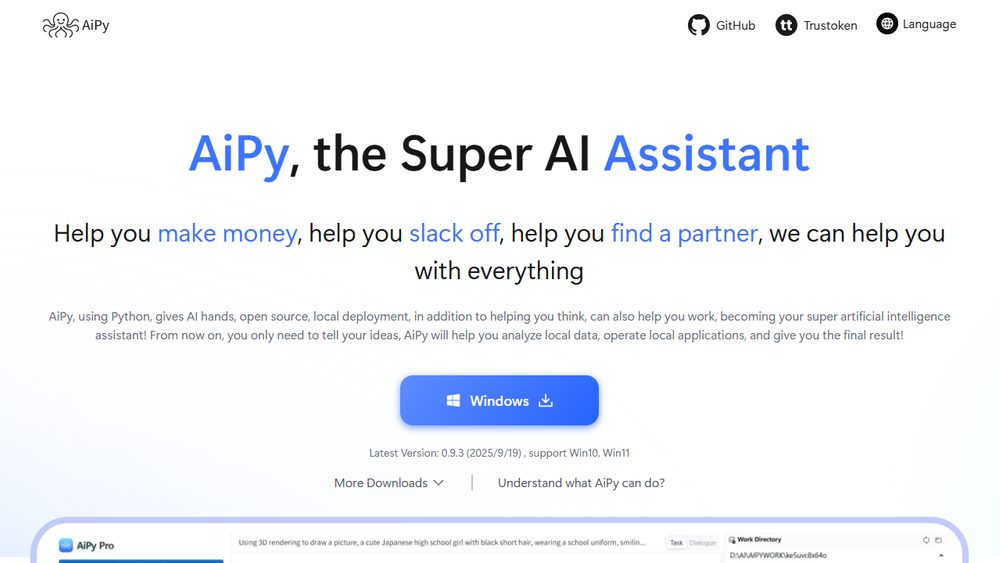
AiPy is a revolutionary AI-powered application that bridges the gap between advanced AI capabilities and practical, real-world task execution. At its core, AiPy is an LLM (Large Language Model) integrated with Python programming, enabling it to not only understand complex instructions but also to write, run, and control Python code to achieve desired outcomes. This unique approach positions AiPy as a powerful "Super AI Assistant" designed to augment human capabilities across a wide spectrum of activities.
Core Features and Functionality:
- Task Understanding and Planning: AiPy leverages the power of LLMs to comprehend user requests, breaking down complex tasks into actionable steps. It can then formulate a plan, often in the form of Python code, to execute these steps.
- Code Generation and Execution: A key differentiator of AiPy is its ability to automatically generate Python code based on the understood task. This code is then executed within the AiPy environment, allowing it to interact with the system and perform actions.
- Control and Automation: AiPy can control various aspects of your computer and local network. This includes operating local applications, managing files, interacting with devices, and even controlling network printers. This level of control allows for significant automation of repetitive or complex tasks.
- Local Deployment and Data Privacy: AiPy supports local installation, which is a significant advantage for users concerned about data privacy. Sensitive data and documents can be processed locally without being uploaded to the cloud, ensuring security and compliance.
- Open Source and Extensibility: Being open-source, AiPy encourages community contribution and allows for customization. Developers can extend its capabilities by integrating new tools, APIs, and models.
- Versatile Applications: The potential applications of AiPy are vast. It can assist in everything from making money and automating mundane tasks to finding information, analyzing data, and even helping with creative endeavors. Examples include generating reports from laboratory data, developing game code, reviewing legal documents, and extracting speech from video files.
- Python-Use Paradigm: AiPy is built upon a novel "Python-Use" paradigm, which emphasizes enabling AI to use Python and Python to use AI. This means that instead of relying on a multitude of pre-defined agents, AiPy uses the LLM to dynamically generate code that acts as the agent, making it more flexible and powerful.
Target Users:
AiPy is designed for a broad audience, including:
- Developers: To accelerate coding, automate development tasks, and experiment with AI-driven code generation.
- Researchers and Data Scientists: For efficient data analysis, local data processing, and automating complex analytical workflows.
- Business Professionals: To streamline operations, automate report generation, contract review, and improve overall productivity.
- Students: To assist with assignments, coding projects, and understanding complex concepts.
- Enthusiasts and Hobbyists: To explore the capabilities of AI and automate personal projects.
- Anyone seeking to enhance their productivity and leverage AI for practical tasks.
AiPy represents a significant step forward in the practical application of AI, moving beyond simple Q&A to become a true task-oriented assistant that can "think and do." Its open-source nature, local deployment capabilities, and powerful code generation and execution features make it a compelling tool for anyone looking to harness the full potential of artificial intelligence.


