

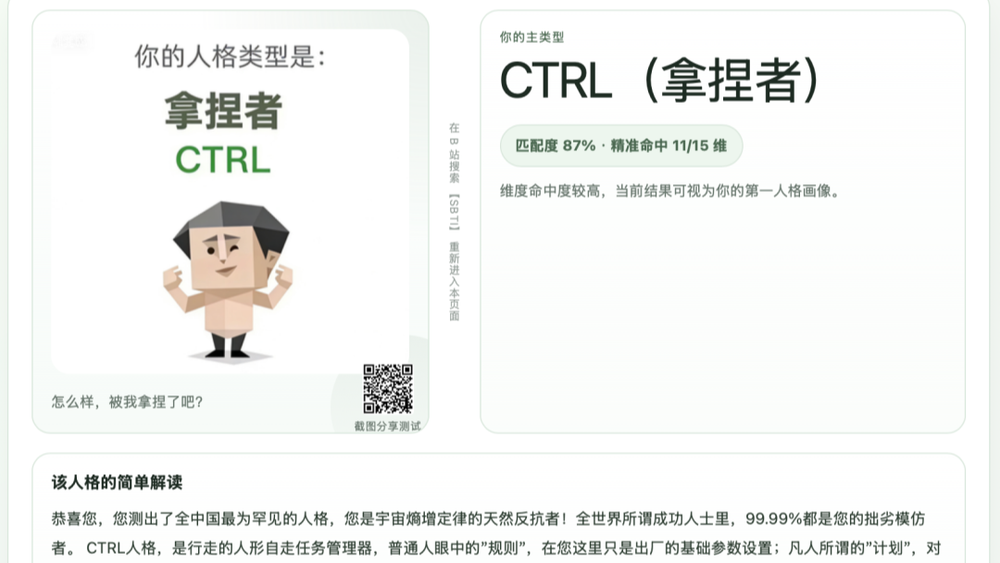
The SBTI Personality Test: A Deep Dive into Silly, Big Personalities
In the ever-expanding universe of online quizzes and personality assessments, the SBTI (Silly Big Personality Test) has emerged as a viral sensation, captivating users with its unique blend of humor, absurdity, and surprisingly relatable insights. Unlike traditional personality tests that aim for scientific accuracy and deep psychological profiling, SBTI boldly declares its purpose: pure entertainment. This guide will delve into the origins, mechanics, features, and cultural impact of the SBTI, exploring why a test that openly admits its inaccuracy has resonated so strongly with a global audience.
Origins and The Viral Phenomenon
The SBTI test was created by a popular Chinese Bilibili content creator known as "蛆肉儿串儿" (now Q肉儿串儿). Initially, the test was conceived with a lighthearted, almost satirical intent – to playfully persuade a friend to reduce their alcohol consumption by assigning them a "DRUNK" personality type. However, the test's unconventional questions, absurd scenarios, and hilariously self-deprecating labels quickly struck a chord, transcending its original purpose to become a widespread internet meme and a popular social media trend.
The test's virality can be attributed to several factors:
- Relatability through Absurdity: While the questions are intentionally nonsensical, they often tap into common anxieties, social pressures, and internal monologues that many people experience. The humor arises from the exaggerated and unexpected ways these feelings are presented.
- Shareability: The unique and often embarrassing or flattering (in a funny way) results are highly shareable, encouraging users to post their outcomes on social media platforms, sparking conversations and inviting others to take the test.
- Low Barrier to Entry: The SBTI is free to take, requires no registration, and delivers results within minutes, making it easily accessible and quick to complete.
- Nostalgia and Satire: The test playfully mocks the very concept of personality assessments, tapping into a cultural awareness of the limitations and sometimes overly serious nature of such tools. It offers a refreshing, lighthearted alternative.
How the SBTI Works: A Journey into the Unconventional
The SBTI is structured as a series of multiple-choice questions, typically around 31 in number. However, the similarity to traditional tests ends there. The questions are designed to be anti-conventional, often presenting bizarre scenarios or asking users to make random choices with humorous justifications.
Examples of SBTI's Question Style:
- "This question has no question, please guess randomly." Options might include: "Think hard and feel like you should pick A," or "Don't know? Pick C." This directly satirizes the pressure to overthink simple choices in personality tests.
- Scenarios involving absurd choices: Questions might present hypothetical situations with wildly illogical or humorous options, forcing users to engage with the test's playful premise.
- Self-referential humor: The test often breaks the fourth wall, acknowledging its own nature as a meme and its creator's intentions.
The Hilarious Labels: Beyond MBTI and Big Five
One of the most distinctive features of the SBTI is its output. Instead of assigning users to established personality types like "INTJ" or "The Mediator," SBTI bestows upon them hilariously self-deprecating or comically specific "mental state" labels. These labels are designed for laughs and often reflect common, albeit exaggerated, modern anxieties and social archetypes.
Popular SBTI Labels Include:
- MALO (吗喽 - Monkey): This label, derived from a Cantonese dialect term for "monkey," describes the "monkey boss" state of wanting to go crazy and lie flat at work. It captures the feeling of being overworked and underappreciated, performing tasks with a sense of frantic, yet resigned, energy.
- DEAD (死者 - Dead Person): This label signifies a state of extreme physical and mental exhaustion, often associated with the dread of Mondays and the relief of Fridays. It's the "zombie" state where work feels like it drains all life force.
- ATM-er (送钱者 - Money Giver): This archetype represents the "good guy" who consistently pays for friends, treats others, and often ends up covering expenses. They are the ones who "disappear" when the bill comes or forget to let others pay for food delivery.
- DRUNK (酒鬼 - Alcoholic): Originally designed to discourage drinking, this label humorously points to an individual's relationship with alcohol. It playfully suggests a tendency towards intoxication, serving as a lighthearted warning about health.
- CRAB (卷王 - Overworker/King of Competition): This label describes the "overworking nerd" or "king of competition" who is perpetually engaged in work or study. They are characterized by constant overtime and a relentless drive to outperform others, often at personal cost.
- LAZY (摆烂王 - King of Slacking Off): The antithesis of the CRAB, the LAZY individual prioritizes rest and relaxation. Their life's pursuit is "lying flat" (内卷 - involution, a term describing intense, often futile competition) and finding new ways to slack off effectively.
These labels, while not scientifically validated, serve as a fun and engaging way for users to categorize themselves and their friends, sparking recognition and laughter.
Unique Features and User Experience
The SBTI test is celebrated for its user-friendly design and unique features that enhance the entertainment value:
- Absurd Question Style: As mentioned, the questions are the core of the SBTI's humor, deliberately deviating from standard psychological inquiries.
- Modern Relevance: The labels, though exaggerated, often tap into contemporary cultural sentiments, particularly among younger demographics who grapple with work-life balance, social pressures, and the "hustle culture" versus "lying flat" dichotomy.
- Multi-Dimensional Scoring: Beyond the main label, the SBTI often provides scores across various dimensions like anxiety, procrastination, and aggression. Crucially, the test reminds users that these scores are also "totally inaccurate," reinforcing the playful nature of the assessment.
- Ease of Participation: The test is designed for quick and effortless completion. With approximately 31 questions, it can be finished in 3-5 minutes, making it ideal for casual engagement, sharing in group chats, or playing with friends.
- No Registration Required: Users can take the test without creating an account or providing personal information, ensuring privacy and immediate access.
Use Cases and Target Audience
The SBTI is primarily aimed at:
- Social Media Users: Individuals looking for fun content to share and discuss online.
- Young Adults and Gen Z: Demographics that often engage with meme culture, relatable humor, and critiques of traditional systems.
- Groups of Friends: A perfect activity for casual get-togethers, icebreakers, or simply to share laughs and discover "what kind of silly" they are.
- Anyone Seeking Lighthearted Entertainment: Individuals who want a break from serious or demanding online activities and are looking for a quick, amusing diversion.
It's important to reiterate that the SBTI is explicitly an entertainment-focused test. It is not intended for self-discovery in a psychological sense, nor should its results be used for serious decision-making or self-assessment. Its value lies in its ability to generate conversation, laughter, and a shared sense of humorous self-awareness.
Technical Implementation and Accessibility
The SBTI test is typically hosted on a web platform, accessible via a browser. The implementation often involves:
- Frontend Development: Using frameworks like React or Vue.js to create an interactive and responsive user interface. The HTML structure, as seen in the provided content, indicates a Next.js application, common for modern web development, offering server-side rendering and optimized performance.
- Backend Logic: While the test itself is designed to be simple and results are often client-side generated for speed, a backend might be used for analytics, tracking popular results, or managing the website hosting.
- Styling: Modern CSS frameworks like Tailwind CSS are evident in the class names, ensuring a clean, responsive, and visually appealing design across various devices.
- Hosting: The website is hosted on a domain (aihappyhorses.com), indicating a standard web hosting setup. The use of Next.js suggests potential deployment on platforms like Vercel.
The accessibility of the test is a key feature, allowing anyone with an internet connection and a web browser to participate without technical hurdles.
Conclusion: The Power of Playful Self-Reflection
The SBTI Personality Test stands as a testament to the power of humor and shared cultural moments in the digital age. By embracing absurdity and self-awareness, it offers a refreshing antidote to the often overly serious nature of online assessments. While it may not provide profound psychological insights, it excels at its stated goal: providing entertainment, sparking conversations, and reminding us not to take ourselves too seriously. Its viral success underscores a collective desire for lighthearted engagement and relatable humor in our increasingly complex digital lives. Whether you're a "MALO" wanting to lie flat or a "CRAB" determined to overwork, the SBTI invites you to discover your "silly, big personality" and share a laugh along the way.


