Subscribe to our newsletter for the latest news and updates
Kling 3.0 vs Seedance 2 vs Veo 3.1 vs Sora 2: The Ultimate AI Video Comparison
A comprehensive third-party benchmark comparing the top four AI video generators: Seedance 2.0 leads in physics and audio, Sora 2 offers cinematic polish, Kling 3.0 excels in motion, and Veo 3.1 provides broadcast-ready quality.
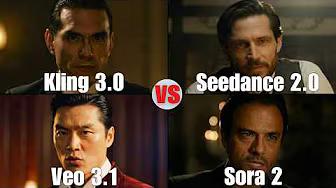
In the rapidly evolving landscape of AI video generation, four titans currently dominate the conversation: Kling 3.0 (Kuaishou), Seedance 2.0 (ByteDance), Veo 3.1 (Google), and Sora 2 (OpenAI). This comprehensive benchmark analysis pits these models against each other across multiple dimensions—physical realism, cinematic quality, narrative coherence, and audio fidelity.
Based on extensive testing across identical prompts and scenarios, the verdict is clear: Seedance 2.0 emerges as the undisputed champion for action-packed scenes with superior physics and audio sync, while Sora 2 delivers an unexpectedly polished "movie-like" aesthetic that surpasses initial expectations. Kling 3.0 remains a powerful contender with excellent motion quality but occasional artifacts, whereas Veo 3.1, despite its broadcast-ready polish, struggles with consistency in this competitive field.
Embedded comparison video showcasing model outputs from identical prompts.
1. Introduction: The State of AI Video in 2026
The year 2026 marks a pivotal moment where AI video generation has transcended its "novelty" phase and entered the realm of professional production tools. The release of Sora 2 in late 2025 set a new benchmark for narrative realism, prompting competitors to accelerate their development cycles. Google's Veo 3.1 responded with enhanced audio capabilities and extended clip lengths, while Chinese giants ByteDance and Kuaishou unleashed Seedance 2.0 and Kling 3.0, respectively, focusing on multimodal inputs and native audio generation.
This comparison is based on a controlled test suite involving prompts related to action sequences (fight scenes, sports), character consistency, and complex motion physics. The goal is to determine which model excels in specific creative workflows, from indie filmmaking to viral social media content.
2. Technical Specifications & Release Timeline
Seedance 2.0 (ByteDance)
Release Date: February 2026
Core Architecture: Dual-branch Diffusion Transformer for parallel visual and auditory processing.
Max Duration: Up to 60 seconds with native multi-shot narrative capabilities.
Overall Impression: Seedance 2.0 is a beast when it comes to kinetic energy and sound design. While it stumbled slightly in our specific "diving" prompt test (generating minor anatomical errors), it absolutely dominated in combat scenes and physical feedback.
Physical Realism: In fight scenes, the impact of punches and kicks feels visceral. The model accurately simulates momentum transfer, cloth dynamics, and environmental interactions (e.g., dust kicking up, objects breaking). This level of physical accuracy is currently unmatched by its peers in high-motion scenarios.
Audio Generation: This is Seedance's killer feature. The native audio is not just background noise; it's precisely synced to the action. Footsteps match the gait, punches have a satisfying "thud," and environmental sounds are spatially accurate. This eliminates the need for extensive post-production sound design.
Weakness: As noted in our test, it can occasionally misinterpret complex prompts involving precise human poses (like diving), leading to unnatural limb positioning. However, this is a minor flaw compared to its strengths in dynamic scenes.
3.2 Kling 3.0: The Motion Specialist with Minor Artifacts
Overall Impression: Kling 3.0 delivers incredibly smooth and fluid motion, making it excellent for dance sequences and fluid character animation. However, it sometimes sacrifices photorealism for stylized motion, leading to noticeable "glitches."
Motion Quality: Kling's motion is often described as "viral" or highly engaging. It handles complex character movements with grace, especially in social media-style content.
Lip-Sync: Its integrated lip-sync technology is highly accurate, making it a top choice for dialogue-heavy clips.
Weakness (Artifacts): As observed in testing, Kling 3.0 can produce visual artifacts or "breakthroughs" where objects clip through each other or backgrounds warp unnaturally. Its physics simulation, while good, is not as robust as Seedance 2.0's in high-impact scenarios.
3.3 Sora 2: The Unexpected Cinematic Contender
Overall Impression:Sora 2 is better than expected. Moving beyond its predecessor's limitations, Sora 2 now generates videos with a distinct "film-like" quality. It doesn't just look real; it looks like it was shot by a cinematographer.
Cinematic Polish: Sora 2 outputs often feature a subtle color grading or "film filter" that enhances the mood. The lighting is dramatic, and the compositions are artistically pleasing. It feels less like raw AI generation and more like a finished product.
Narrative Coherence: It excels at maintaining character consistency and logical scene progression over longer durations (up to 60 seconds), making it ideal for short film concepts.
Weakness: While its physics have improved, it still lags slightly behind Seedance in simulating raw, chaotic physical interactions. It prioritizes aesthetic beauty over brute-force realism.
3.4 Veo 3.1: The Broadcast-Ready Underperformer
Overall Impression: Veo 3.1 produces clean, professional-looking footage with excellent resolution and color fidelity. However, in head-to-head comparisons, its outputs often feel sterile and lack the "soul" of its competitors.
Technical Quality: The videos are sharp, well-lit, and free of major distortions. It's the safest choice for corporate videos or broadcast content where technical perfection is paramount.
Weakness (Character): In our tests, Veo 3.1 consistently ranked last in terms of engagement. The characters felt robotic, the movements were slightly stiff, and it struggled the most with complex action prompts. While it has native audio, the sync often feels less organic than Seedance's.
4. Head-to-Head Benchmark Results
Metric
Seedance 2.0
Kling 3.0
Sora 2
Veo 3.1
Physics & Motion
★★★★★ (Best)
★★★★☆ (Smooth but artifacts)
★★★★☆ (Cinematic, less raw)
★★★☆☆ (Stiff)
Audio Sync & Quality
★★★★★ (Native, precise)
★★★★☆ (Good lip-sync)
★★★★☆ (Native, atmospheric)
★★★☆☆ (Functional)
Cinematic Feel
★★★★☆ (Raw energy)
★★★☆☆ (Stylized)
★★★★★ (Film-grade)
★★★★☆ (Broadcast)
Character Consistency
★★★★☆
★★★☆☆
★★★★★
★★★☆☆
Prompt Adherence
★★★★☆
★★★★☆
★★★★★
★★★☆☆
5. Use Case Recommendations
Choose Seedance 2.0 if: You need high-octane action scenes, realistic sound effects, or content where physical impact is crucial (e.g., fight choreography, sports highlights).
Choose Kling 3.0 if: You prioritize fast generation speed, need excellent lip-sync for talking-head videos, or are creating stylized social media content where perfect realism is less important.
Choose Sora 2 if: You are creating short films, narrative sequences, or any content where a cinematic aesthetic and emotional tone are more important than hyper-realistic physics.
Choose Veo 3.1 if: You need broadcast-quality resolution for corporate presentations or technical demos where visual fidelity trumps creative expression.
6. Conclusion
The AI video generation race is no longer about who can make a video look "real." It's about specialization. Seedance 2.0 has carved out a niche as the master of physics and audio, delivering unparalleled realism in dynamic scenes. Sora 2 has matured into a true storytelling tool with its filmic quality. Kling 3.0 remains the go-to for fast, expressive motion, while Veo 3.1 holds the line for technical excellence.
For creators looking for the most versatile and powerful model for general use—especially for action and audio-rich content—Seedance 2.0 currently holds the crown. However, for filmmakers seeking a specific mood and visual style, Sora 2 is now a genuinely viable option.