
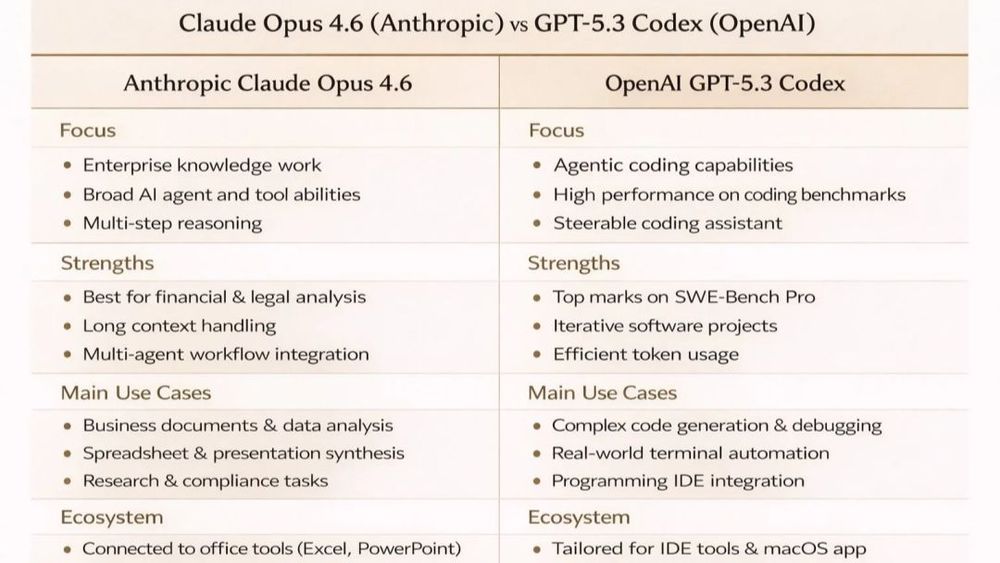
Claude Opus 4.6 vs GPT-5.3 Codex
A neutral, practitioner-oriented evaluation from a third-party perspective
Two frontier releases landed almost simultaneously: Anthropic’s Claude Opus 4.6 and OpenAI’s GPT-5.3 Codex. Both are framed not merely as “better LLMs,” but as steps toward autonomous, tool-using agents that can code, operate software, and complete real work across domains.
This review focuses on what matters to builders and knowledge workers:
- What the benchmarks actually suggest (and where they don’t align)
- What changed at the product and agent level
- Where each model appears to be stronger in practice
- How these advances affect real workflows
1. Benchmark Signals — Strong, but Not Directly Comparable
As always, raw scores are informative but not decisive. The complication here is that the two vendors often report results on different versions of similar benchmarks, or use different evaluation protocols. That makes naive score comparison misleading.
Still, some signals stand out.
Terminal-Bench 2.0 (coding in real terminal environments)
This is one of the few directly aligned benchmarks across both models: 89 complex tasks executed inside isolated Docker containers.
- Claude Opus 4.6: 65.4%
- GPT-5.3 Codex: 77.3%
On this shared test, GPT-5.3 Codex leads by a wide margin. This aligns with the historical strength of the Codex lineage in real debugging, shell interaction, and repository-level reasoning.
OSWorld (computer-use agent capability)
This benchmark measures how well a model can operate a computer: clicking, navigating apps, managing windows, etc.
However:
- Claude reports results on the original OSWorld
- GPT reports results on OSWorld-Verified, a later, stricter rebuild that removed hundreds of evaluation flaws
This means the two scores are not measuring the same thing. Interpreted carefully, GPT’s lower raw score on the stricter version likely indicates very competitive, possibly stronger performance in realistic computer operation tasks.
GDPval (real knowledge work tasks)
This benchmark attempts to measure whether AI can produce deliverables comparable to professionals in domains like finance, law, and business.
- Claude reports an Elo score from an external evaluation framework
- GPT reports a win/tie rate against human outputs using a different methodology
There is no clean conversion between these metrics. The only safe conclusion: both models are now highly capable in real knowledge work scenarios, not just coding.
SWE-bench (real GitHub issue repair)
Both models report strong results here, but again on different subsets:
- Claude uses a verified Python-only subset with human-validated issues
- GPT uses a multi-language, larger, more complex public benchmark
Raw numbers differ, but the difficulty levels differ too. Interpreted cautiously, both models are near the frontier of automated repository repair.
2. Claude Opus 4.6 — The “Long-Horizon Agent” Upgrade
The most important changes in Opus 4.6 are not the scores. They are architectural and product-level.
1M token context window
This is transformative for:
- Large codebases
- Long legal/financial documents
- Multi-file audits
- Repository-level reasoning
Crucially, large context is only useful if the model can retain reasoning quality. Opus 4.6 shows strong performance on long-context retrieval and reasoning tests designed to detect “context rot” (performance degradation over time).
This makes it practical to drop hundreds of pages or entire projects into a single session.
128K output limit
For report generation, code generation, and document drafting, this matters more than it sounds. It removes many artificial truncation points.
Context Compaction (automatic history summarization)
Long sessions used to die when context filled up. Now the model compresses earlier conversation into summaries automatically, enabling long-running tasks without manual resets.
Adaptive Thinking and Effort Control
Instead of a simple “think harder or not” toggle, Opus now:
- Decides when deep reasoning is needed
- Allows users to tune effort level (speed vs cost vs quality)
This is highly practical in mixed workloads.
Agent Teams (in Claude Code)
This is one of the most interesting product innovations:
- A lead agent coordinates multiple worker agents
- Workers operate in separate contexts
- Workers can communicate directly with each other
- Ideal for tasks like multi-layer code review (frontend, backend, database)
This is different from earlier “sub-agent” patterns. It resembles a collaborative multi-agent system rather than a hierarchy.
Office integrations (Excel & PowerPoint)
Claude is now embedded into Excel and PowerPoint with awareness of:
- Layout
- Templates
- Formatting
- Charts, pivots, validation rules
This is a strong signal that Anthropic is targeting enterprise productivity workflows, not just developers.
3. GPT-5.3 Codex — The “Self-Improving Developer” Model
The most striking aspect of GPT-5.3 Codex is not a benchmark. It’s a statement from OpenAI:
Early versions of the model were used to help develop the model itself.
That means Codex assisted with:
- Debugging training pipelines
- Managing deployment code
- Diagnosing test results
- Improving evaluation systems
In other words, AI participated in its own creation. This has deep implications for how fast model capability can compound.
Strength in real debugging and iteration
Historically, Codex models have excelled at:
- Fixing subtle bugs
- Iterative refinement
- Working inside messy, real repositories
GPT-5.3 Codex appears to extend this significantly.
Interactive long-running Codex sessions
A key usability improvement:
You can now intervene while Codex is working, instead of stopping and restarting. This makes multi-hour autonomous coding sessions far more practical.
Token efficiency and speed
Reports indicate:
- Fewer tokens needed for the same task compared to previous Codex versions
- Faster per-token processing
This translates into noticeably smoother developer experience.
Demonstrated autonomous game development
OpenAI showcased complete, playable games built by Codex through iterative self-improvement using general guidance and bug-fix prompts. These were not trivial demos, but multi-system projects with mechanics, assets, and progression.
This demonstrates something important: sustained autonomous iteration over millions of tokens.
4. Where Each Model Feels Stronger in Practice
From a practitioner standpoint, a pattern emerges:
| Scenario | Likely Strength |
|---|---|
| Massive context, whole-project understanding | Claude Opus 4.6 |
| Long document analysis (legal, finance, reports) | Claude Opus 4.6 |
| Structured productivity tasks (Excel, PPT, office work) | Claude Opus 4.6 |
| Multi-agent coordinated review | Claude Opus 4.6 |
| Debugging stubborn bugs in real repos | GPT-5.3 Codex |
| Iterative coding with continuous feedback | GPT-5.3 Codex |
| Terminal and shell-heavy tasks | GPT-5.3 Codex |
| Long autonomous build-and-refine cycles | GPT-5.3 Codex |
They are converging, but the emphasis differs:
- Claude is optimizing for long-horizon reasoning and coordinated agents
- GPT Codex is optimizing for hands-on software engineering and self-iteration
5. The Emerging Workflow Many Developers Will Recognize
A very natural workflow is emerging:
- Use Claude Opus 4.6 + Claude Code to:
- Understand large systems
- Draft architecture
- Review entire codebases
- Produce structured plans
- Hand off to GPT-5.3 Codex + Codex to:
- Fix edge cases
- Refactor
- Debug
- Iteratively improve
These tools are not mutually exclusive. They are complementary.
6. The Bigger Picture: Both Are Betting on Agents
Both companies are clearly moving beyond “chatbots”:
- Tool use
- Computer control
- Multi-agent coordination
- Long-running autonomous tasks
- Integration into real software environments
This is a shift from question-answering models to digital workers.
Traditional SaaS tools, especially in productivity and development, will increasingly feel pressure from this direction.
Conclusion
Claude Opus 4.6 and GPT-5.3 Codex represent two different interpretations of the same future:
- Claude focuses on context, coordination, and enterprise productivity
- Codex focuses on hands-on engineering, iteration, and self-improvement
Both are state-of-the-art. Neither replaces the other. Together, they define the current frontier of AI-assisted work.
For builders, this is not a question of “which one is better,” but how to combine them effectively.
The tools are here. The limiting factor is now how well we learn to use them.